House edge is the share of every bet a casino expects to keep. A game with a 5% house edge returns an average of 95 cents for each dollar staked on it, and takes the other five. The figure is fixed by the rules of the game, published for most bets, and it is the price you pay to play.
The number itself is easy. What trips people up is the denominator, because house edge is charged on every dollar you wager rather than on the money you walked in with, and those are not remotely the same amount. A $500 bankroll played through a game at $10 a bet can generate several thousand dollars of turnover before it runs out, and the edge is taken from all of it.
What house edge actually is
Take one bet, work out the average amount you lose on it, and divide that by what you staked. Flip the sign and you have the house edge.
The Wizard of Odds, whose published tables are the standard reference for these figures, defines it as the ratio of the average loss to the initial bet. That word "initial" is doing real work, and the section on conflicting figures comes back to it.
Two consequences follow immediately. The first is that house edge is an average over many repetitions, not a description of any single bet: you will win or lose an individual wager, never 5.26% of it. The second is that the edge is a property of the rules, not of your luck or your play. Choosing a different bet changes it. Nothing else you do at the table does.
House edge is also the same quantity as RTP, written from the other side. An edge of 5.26% is an RTP of 94.74%. Slot makers quote the return, table games quote the edge, and the two carry identical information. For the full derivation of the underlying average, see expected value.
How to calculate it for any bet
You need two things: the probability the bet wins, and what it pays. Multiply the payout by the win probability, subtract the probability of losing, and reverse the sign.
A single number in double-zero roulette pays 35 to 1 and wins once every 38 spins:
EV = (+35)(1/38) + (-1)(37/38) = -0.0526
Edge = 5.26%
Now a craps place bet on 4, which pays 9 to 5. There are three ways to roll a 4 against six ways to roll a 7, so the bet wins three times in nine:
EV = (+9/5)(1/3) + (-1)(2/3) = -0.0667
Edge = 6.67%
That is the whole method. Every computed figure in the tables further down this page came out of those two lines of arithmetic, and you can reproduce any of them from a probability and a payout.
The calculation gets harder only when your own decisions change the outcome. Blackjack, video poker and the poker-based table games need combinatorial analysis or simulation to pin down, which is why their edges are published rather than derived at the table. Games of pure chance need nothing beyond the two numbers above, and our dice simulator will price a whole session rather than a single bet.
The edge is not your chance of winning
These are two different percentages and they get treated as one.
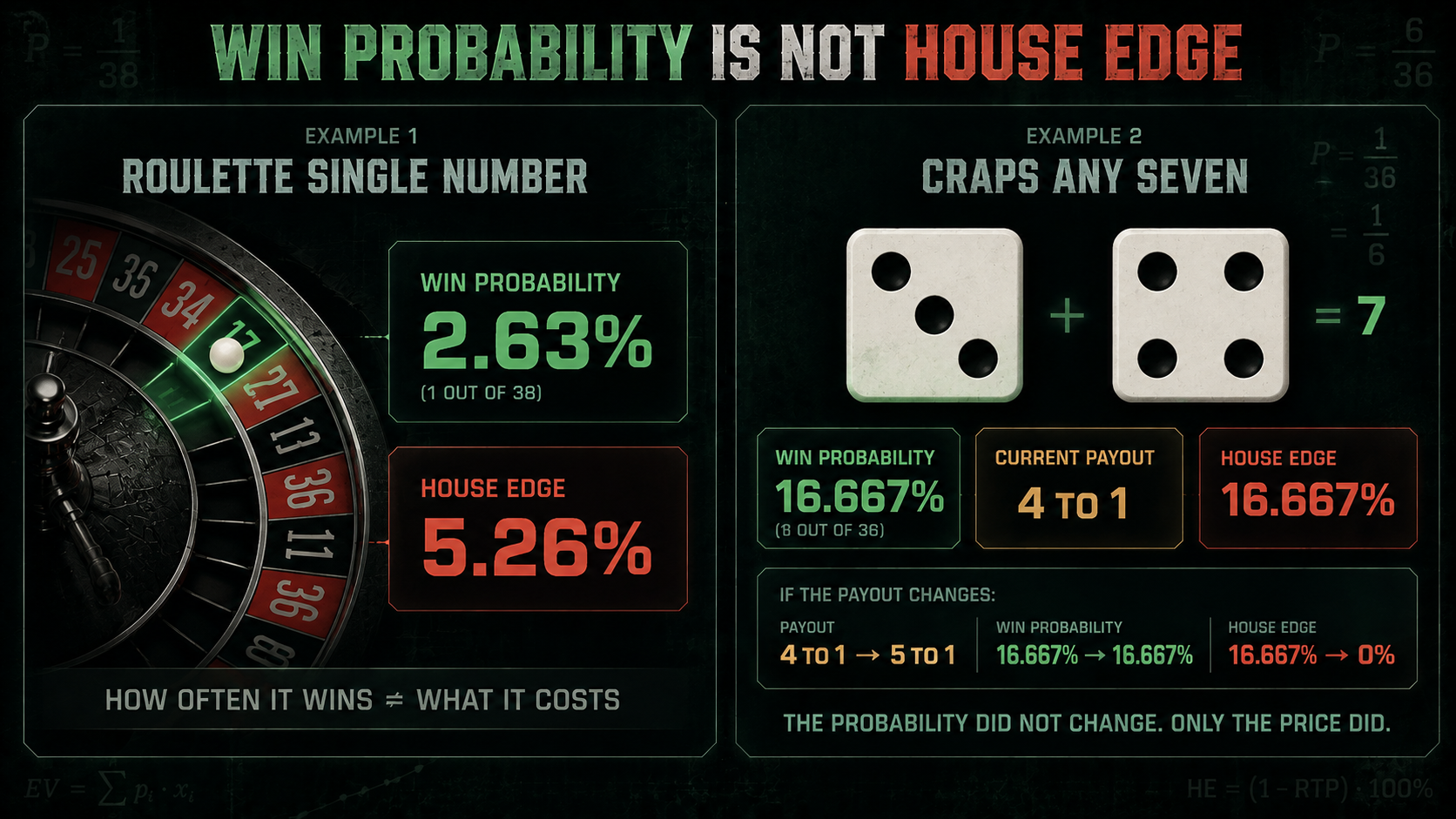
A single number in double-zero roulette wins 2.63% of the time and costs 5.26%. One describes how often the bet comes in, the other describes what it is priced at, and you cannot get from either to the other without knowing the payout as well.
The trap is the craps bet called any seven, which wins 16.667% of the time and carries an edge of 16.667%. Both numbers are right and their being equal is an accident of that payout. Keep the same bet and raise the payout from 4 to 1 up to 5 to 1: the win rate does not move at all, and the edge falls to zero.
Read a price and a probability as separate facts, then. Reading gambling odds covers how to convert between them and why a likelier bet is often the worse deal.
What it costs per dollar wagered
Here is the price list. The middle column is the same figure expressed as a return, and the last one is what the edge extracts from ten thousand dollars pushed across the table.
| House edge | RTP | Cost per $10,000 wagered |
|---|---|---|
| 0.28% | 99.72% | $28.00 |
| 0.50% | 99.50% | $50.00 |
| 1.06% | 98.94% | $106.00 |
| 1.41% | 98.59% | $141.41 |
| 2.70% | 97.30% | $270.27 |
| 5.26% | 94.74% | $526.32 |
| 6.00% | 94.00% | $600.00 |
| 30.00% | 70.00% | $3,000.00 |
Ten thousand dollars sounds like a lot until you notice how fast it accumulates. Betting $10 a hand for four hours at 60 hands an hour puts $2,400 through the game, and any winnings you stake again are counted too. The figure that matters is total turnover, not the size of your bankroll, and confusing the two is the usual reason a published percentage feels smaller than the damage it does. Our RTP page works through that mistake in detail.
What it costs per hour
Money wagered is the honest denominator, but nobody experiences a session in units of turnover. Hours are easier to feel.
Take a $500 bankroll, $10 a bet, and hold the pace at 60 bets an hour so that the only thing varying between rows is the price of the game:
| Game | House edge | Cost per hour | $500 lasts |
|---|---|---|---|
| Craps, free odds | 0.00% | $0.00 | indefinitely, in expectation |
| Blackjack, basic strategy | 0.50% | $3.00 | 167 hours |
| Baccarat, banker | 1.06% | $6.36 | 79 hours |
| Craps, pass line | 1.41% | $8.48 | 59 hours |
| Roulette, single zero | 2.70% | $16.22 | 31 hours |
| Roulette, double zero | 5.26% | $31.58 | 16 hours |
| Slots, typical | 6.00% | $36.00 | 14 hours |
| Keno | 30.00% | $180.00 | 2.8 hours |
Those hours assume you keep betting flat until the money is gone, which nobody actually does, so read them as a comparison between games rather than as a forecast of your evening.
The comparison has a flaw worth naming, though, because holding the pace fixed at 60 bets an hour is not how these games run. A craps player betting only the pass line gets about 30 decisions an hour. A roulette wheel manages around 40 spins. A slot machine will take 600 spins out of you in the same hour.
Correct for that and craps moves ahead of baccarat, because a pass line player is charged half as often:
| Game | Decisions per hour | Staked per hour | Cost per hour |
|---|---|---|---|
| Craps, pass line at $10 | 30 | $300 | $4.24 |
| Blackjack at $10 | 60 | $600 | $3.00 |
| Baccarat at $10 | 60 | $600 | $6.36 |
| Roulette, double zero at $10 | 40 | $400 | $21.05 |
| Slots at $1 a spin | 600 | $600 | $36.00 |
The last two rows are the ones to sit with. A slot player betting a single dollar a spin and a blackjack player betting ten put exactly the same $600 through their games in an hour. The slot player loses twelve times as much, and the entire difference is the price of the game rather than the size of the bet or the speed of the machine. A small stake feels cautious and does nothing to change what the game charges.
This is also why pace belongs in any comparison of two games. A cheap game played fast can cost more per hour than an expensive game played slowly, and the machines that look most modest per spin are the ones that get through the most money.
House edge by game
Every figure below was computed from the probability and the payout, except those in the last table, which need simulation or a full paytable analysis and are credited to their source. Bets are grouped by game so you can see the range inside each one.
Craps
| Bet | Pays | House edge |
|---|---|---|
| Free odds, any point | true odds | 0.00% |
| Don’t pass | 1 to 1 | 1.36% |
| Pass line | 1 to 1 | 1.41% |
| Place 6 or 8 | 7 to 6 | 1.52% |
| Field, layout paying 3 to 1 on the 12 | 1 to 1, with 2 to 1 on the 2 | 2.78% |
| Place 5 or 9 | 7 to 5 | 4.00% |
| Field, layout paying 2 to 1 on the 12 | 1 to 1, with 2 to 1 on the 2 | 5.56% |
| Place 4 or 10 | 9 to 5 | 6.67% |
| Big 6 or Big 8 | 1 to 1 | 9.09% |
| Hard 6 or hard 8 | 9 to 1 | 9.09% |
| Any craps | 7 to 1 | 11.11% |
| Hard 4 or hard 10 | 7 to 1 | 11.11% |
| 2 or 12, single roll | 30 to 1 | 13.89% |
| Any seven | 4 to 1 | 16.67% |
Roulette
| Bet | House edge |
|---|---|
| Single zero, any bet | 2.70% |
| Double zero, any bet except the top line | 5.26% |
| Double zero, top line (0, 00, 1, 2, 3) | 7.89% |
Baccarat
| Bet | House edge |
|---|---|
| Banker, 5% commission | 1.06% |
| Player | 1.24% |
| Tie at 8 to 1 | 14.36% |
Sic bo
| Bet | Pays | House edge |
|---|---|---|
| Small or big | 1 to 1 | 2.78% |
| Any triple | 30 to 1 | 13.89% |
| Specific triple | 180 to 1 | 16.20% |
Big Six wheel
| Segment | Pays | House edge |
|---|---|---|
| $1 | 1 to 1 | 11.11% |
| $2 | 2 to 1 | 16.67% |
| $5 | 5 to 1 | 22.22% |
| $10 | 10 to 1 | 18.52% |
| $20 | 20 to 1 | 22.22% |
| Joker or logo | 40 to 1 | 24.07% |
Note that the edge does not climb steadily with the payout on that wheel: the $10 segment is cheaper than the $5. Segment counts and payouts were set independently of each other, so the prices come out uneven.
Games that need a published figure
| Game | House edge | Source |
|---|---|---|
| Blackjack, liberal Vegas rules, basic strategy | 0.28% | Wizard of Odds |
| Blackjack, common six-deck game, basic strategy | about 0.50% | Hannum, UNLV |
| Video poker, expert play | under 1% on some machines, and a few return over 100% | Hannum, UNLV |
| Slots | typically 5% to 10% | Hannum, UNLV |
| Keno | around 30% | Hannum, UNLV |
Read down the craps table and the useful conclusion appears: the range inside one game is wider than the range between games. A single craps layout offers a bet priced at nothing and a bet priced at 16.67%, and the dice do not know which one you backed. Picking the bet matters more than picking the game, and the two tables show the difference in shape: a roulette player faces one price whatever they back, while a craps player is choosing between fourteen.
The free odds row deserves its footnote. It pays true odds and therefore costs nothing, but it cannot be made on its own: you have to have a pass or don’t pass bet working first, and that bet carries its own edge. The pair still costs money. The odds portion is simply priced honestly. For the full probability tables behind every dice bet above, see dice probability, and for game-by-game recommendations rather than prices, casino games with the best odds.
Why the same game gets two different figures
Look up one game in two places and the numbers often disagree. Usually both are right and they answer slightly different questions.
The bet grew. House edge is conventionally measured against the initial wager, but in blackjack, Let It Ride and Caribbean Stud the amount at risk changes mid-hand as you double, split or pull bets back. Measure against the money finally exposed and you get a smaller percentage for the same expected loss. The Wizard of Odds calls that second view the element of risk, and our casino math reference works through an example.
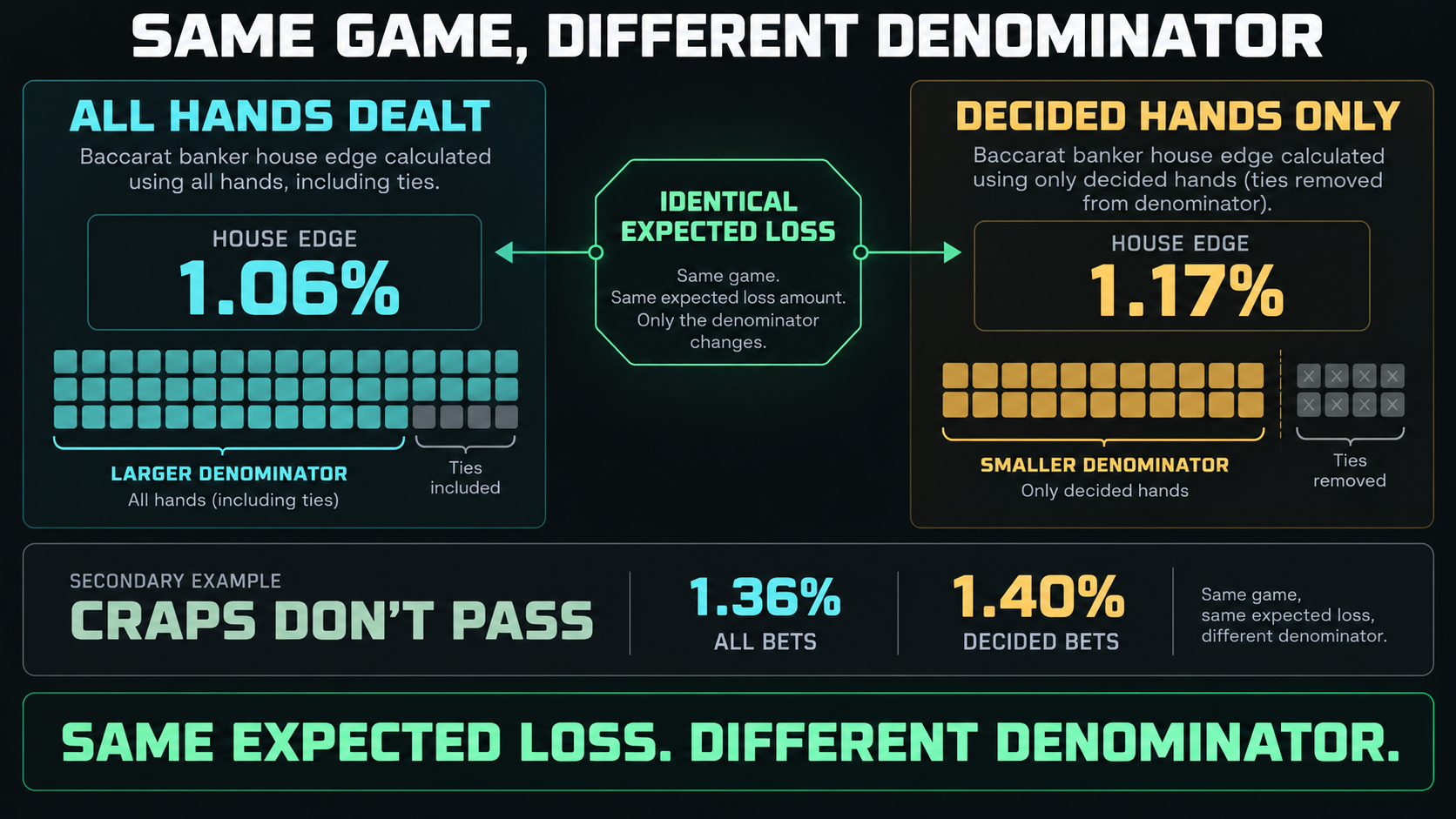
Ties counted, or not. Baccarat’s banker bet costs 1.06% of every hand dealt and 1.17% of hands that actually resolve. The don’t pass bet in craps runs 1.36% or 1.40% on the same distinction, and nothing has moved except whether pushes sit in the denominator.
Optimal play was assumed. Every published blackjack figure assumes correct basic strategy. Hannum notes that the average player hands the casino roughly 2% through mistakes and departures from that strategy, against the 0.5% a correct player faces. The published number is a floor available to someone who has done the work, not a description of what happens at a real table.
So before comparing two percentages, check that they were measured the same way. A figure quoted against the initial bet is not comparable with one quoted against total money wagered.
What house edge does not tell you
It does not tell you what will happen tonight. The edge is a long-run rate, and over any realistic session the randomness is far larger than the price. A thousand pass line bets carry an expected loss of 14 units and a standard deviation of 32, so finishing ahead is entirely ordinary. Our RTP page covers how many bets convergence actually needs, and risk of ruin covers the chance the bankroll runs out first.
It does not tell you how much you will lose in an evening either, because that depends on turnover and pace as much as on the percentage, and the hourly tables above show how far apart those answers can be.
And it is not a strategy. The edge is written into the rules of each bet, so the only lever you have is which bet you make. There is no betting pattern, progression or staking system that changes the price of a game, because every such system is just a sequence of bets that each carry their own edge.
FAQ
What is a casino house edge?
The percentage of each wager a casino expects to keep over the long run. A 5.26% house edge means that for every dollar staked, the average return to the player is about 94.7 cents. It is set by the rules of the bet, applies to every dollar wagered rather than to your starting bankroll, and describes an average across many bets rather than the outcome of any one.
Which casino game has the lowest house edge?
The free odds bet in craps is priced at true odds and costs nothing, though it can only be added to a pass or don’t pass bet that carries an edge of its own. Among bets you can make on their own, blackjack with basic strategy is the cheapest: 0.28% under liberal rules, and around 0.5% in a common six-deck game. Baccarat’s banker bet follows at 1.06%, then the craps pass line at 1.41%. Certain full-pay video poker machines beat all of these with expert play.
How do you calculate house edge?
Multiply what the bet pays by the probability it wins, subtract the probability that it loses, then reverse the sign. For a 35 to 1 payout on a 1 in 38 chance, that is 35 times 1/38 minus 37/38, which comes to minus 0.0526, so the edge is 5.26%.
Is house edge the same as RTP?
They are the same quantity written two ways, and the pair always adds to 100%. A 4% house edge is a 96% RTP. Table games conventionally quote the edge and slot makers quote the return, so which term you meet depends mostly on what you are playing.
Can you beat the house edge?
You can lower it by choosing better bets, which is worth doing and can cut the price of an hour by a factor of ten or more. You cannot remove it by betting patterns, staking systems or timing, because the edge lives in the rules of each individual bet. The genuine exceptions are narrow: the free odds bet, a handful of full-pay video poker paytables played perfectly, and the occasional promotion a casino has priced wrong.