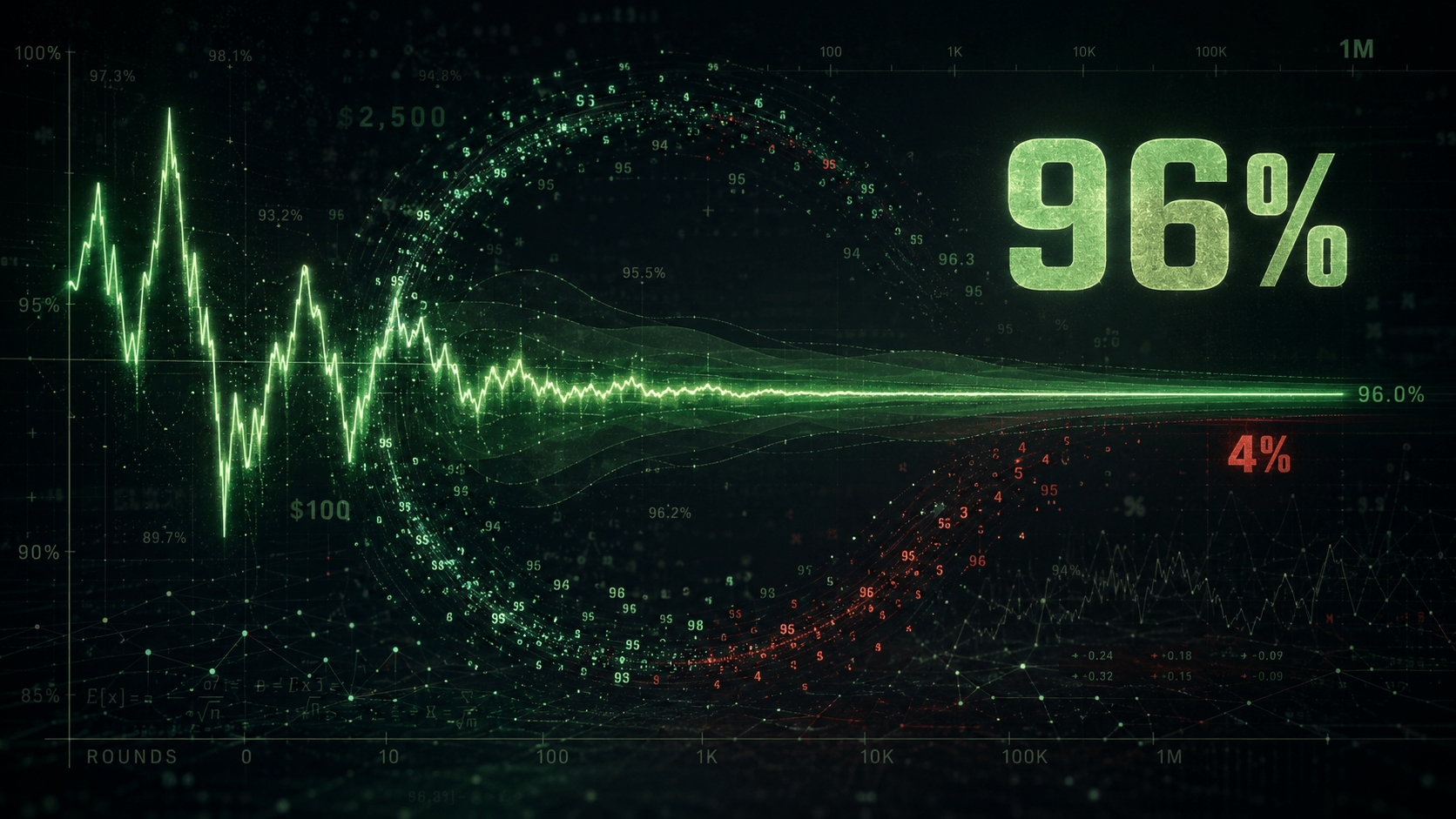
Return to player is the share of all money wagered on a casino game that the game pays back out, measured across its entire lifetime rather than across your session. A game published at 96% keeps four cents of every dollar ever staked through it. It does not mean you will finish the night down four percent, and the gap between those two readings is where almost every misunderstanding about RTP begins.
The number is real, regulated and worth knowing. It is also the most over-interpreted figure in gambling.
This guide covers what RTP measures, how it converts to house edge, and how many bets it takes before the percentage means anything at all. It also covers why volatility matters more than RTP over any realistic number of rounds, and why the highest RTP you will find anywhere is not attached to a slot.
What RTP actually measures
RTP has a definition you can compute rather than a marketing sense. The UK Gambling Commission states the method for actual return plainly: divide wins by turnover.
Actual RTP = wins ÷ turnover
Their own worked example puts 1,085,000 in wins against 1,200,000 in turnover, which gives 0.9042, or 90.42%. Turnover is every unit staked, not the money players deposited, and wins are every unit paid back out. Both figures accumulate across all players.
That aggregation is the part the name hides. The "player" in return to player is not you. It is the entire population of everyone who has ever played that game, summed over every round. Your own realised return is a sample from that population, and a small one.
Games ship with a theoretical RTP, calculated by the designers from the game's own maths and checked during external testing. The actual RTP is whatever the turnover produces once real people play. The regulator's expectation is that after enough plays the actual figure lands very close to the theoretical one, and the interesting question is what "enough" means. We get to that below with numbers.
RTP and house edge are the same number
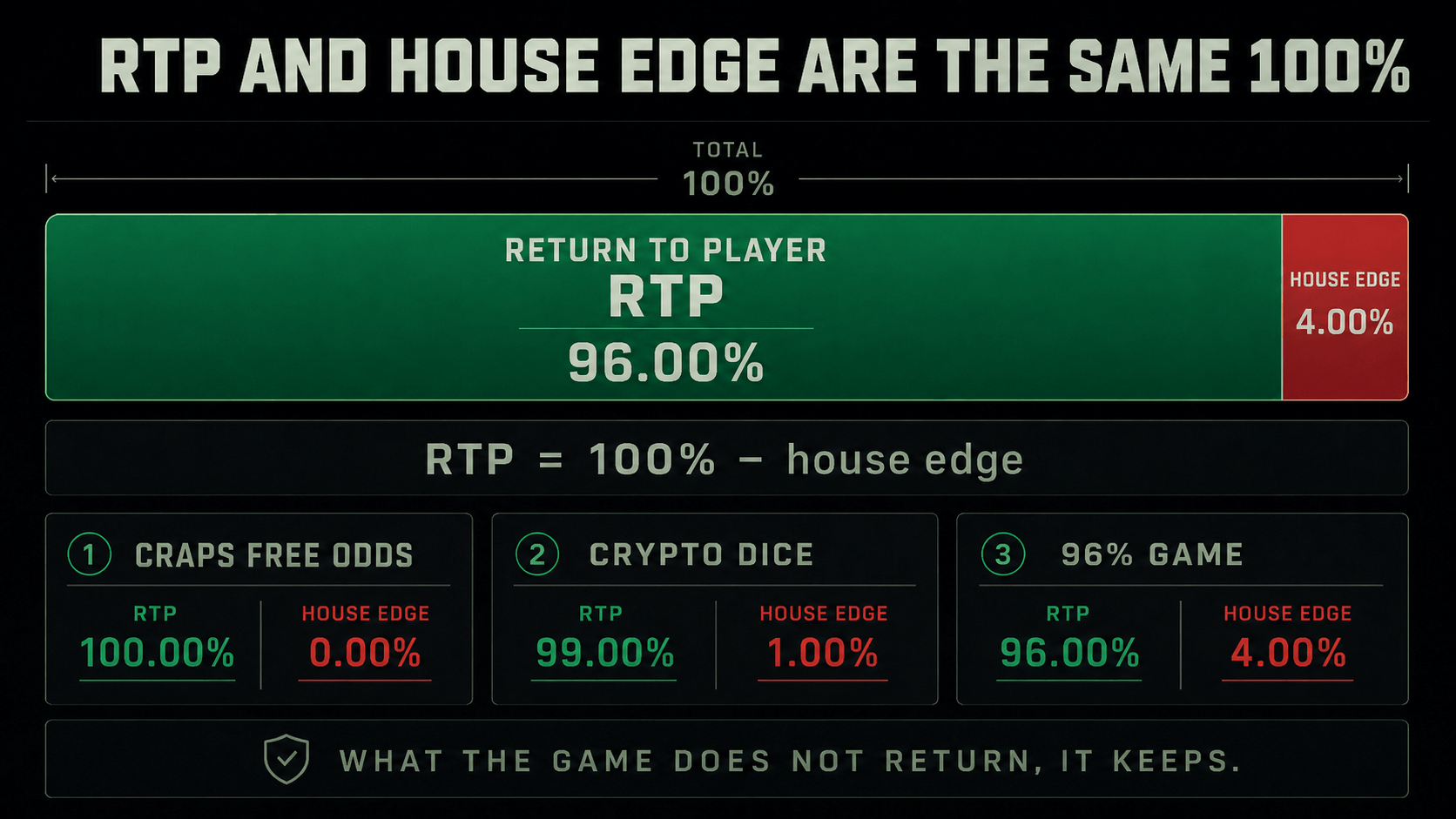
These are two names for one quantity, seen from opposite sides of the table:
RTP = 100% − house edge
Everything a game does not return, it keeps. A 2.78% house edge is a 97.22% return, and a 97.22% return is a 2.78% house edge. There is no third quantity hiding between them.
| Bet | House edge | RTP |
|---|---|---|
| Craps free odds | 0.00% | 100.00% |
| Crypto dice at a 1% edge | 1.00% | 99.00% |
| Craps pass line | 1.41% | 98.59% |
| Craps place 6 or 8 | 1.52% | 98.48% |
| European roulette | 2.70% | 97.30% |
| Sic bo Small or Big | 2.78% | 97.22% |
| American roulette | 5.26% | 94.74% |
Slots are quoted as RTP and table games are quoted as house edge, which is convention rather than mathematics. The convention flatters the slot. "This game returns 96%" and "this game keeps 4% of everything you stake" describe the same machine, and only one of them sounds like a feature. Our page on house edge works through the calculation from the other direction, and expected value covers the per-bet arithmetic underneath both.
How long is the long run?
Every RTP figure comes wrapped in a phrase like "over the long term", and almost nobody puts a number on it. Here is the number.
Take an even-money bet with the pass line's house edge of 1.41%, so an expected RTP of 98.59%. After N independent bets, your realised return has a standard deviation of roughly one over the square root of N. That gives the range your actual results will fall inside about two thirds of the time:
| Bets resolved | One-sigma spread | Realised RTP lands between |
|---|---|---|
| 100 | ±10.00 points | 88.59% and 108.58% |
| 1,000 | ±3.16 points | 95.42% and 101.75% |
| 10,000 | ±1.00 point | 97.59% and 99.59% |
| 100,000 | ±0.32 points | 98.27% and 98.90% |
| 1,000,000 | ±0.10 points | 98.49% and 98.69% |
Read the 1,000-bet row again. The noise is ±3.16 percentage points, which is more than twice the entire house edge of 1.41 points. A thousand resolved bets is a long session for most people, and at that scale the edge is still buried inside the randomness. You could finish those thousand bets at a realised 101.75% and conclude the game pays over 100%, and you would be wrong in a completely unremarkable way.
The Gambling Commission publishes its own version of this, expressed as the tolerance it will accept between actual and theoretical RTP at a 95% confidence level. At 50,000 games the tolerance is ±4.91 percentage points. At 1,000,000 games it narrows to ±1.10 points. Their figures depend on each game's volatility rather than assuming an even-money bet, which is why they are wider than the table above, but the shape of the answer is identical: convergence needs six figures of rounds, not three.
RTP is a property of the game, in the same way that a coin's fairness is a property of the coin. Neither tells you what the next hundred trials will do.
Volatility: everything RTP leaves out
Two bets can carry a similar expected return and behave nothing alike, because RTP says nothing about the shape of the distribution around it. Volatility is what fills that gap, and over any short run it dominates.
Here are three bets, all run for the same 1,000 rounds:
| Bet | Expected RTP | One-sigma spread | Realised RTP lands between |
|---|---|---|---|
| Even-money bet, 1% edge | 99.00% | ±3.16 points | 95.8% and 102.2% |
| Sic bo any triple at 30 to 1 | 86.11% | ±16.11 points | 70.0% and 102.2% |
| Sic bo specific triple at 180 to 1 | 83.80% | ±38.85 points | 44.9% and 122.7% |
The last row is the one to sit with. A thousand bets on a specific triple can produce a realised return anywhere from 45% to 123%, and both ends of that range are ordinary. Quoting an RTP of 83.80% for such a bet is technically correct and practically useless, because you will essentially never observe it.
Notice also that all three rows reach roughly 102% at the top. High volatility is exactly what makes a bad bet feel winnable: it widens the upside along with the downside, and the upside is what people remember. What it also does is bring ruin forward, which is the subject of risk of ruin.
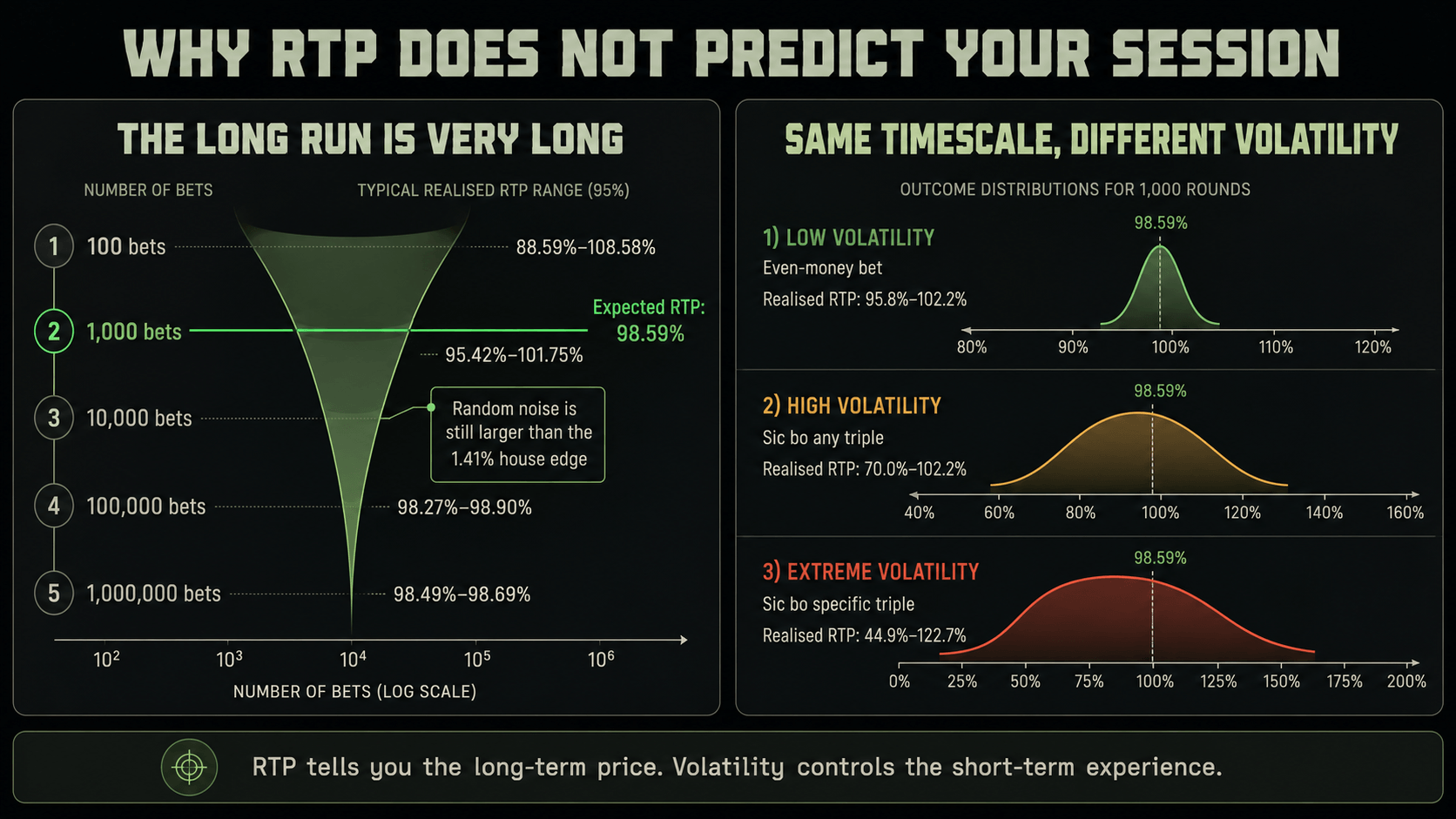
So when you compare two games, RTP tells you what they cost and volatility tells you how violently they will charge it. A 96% low-volatility game and a 96% high-volatility game are the same price and entirely different experiences.
The mistake almost everyone makes
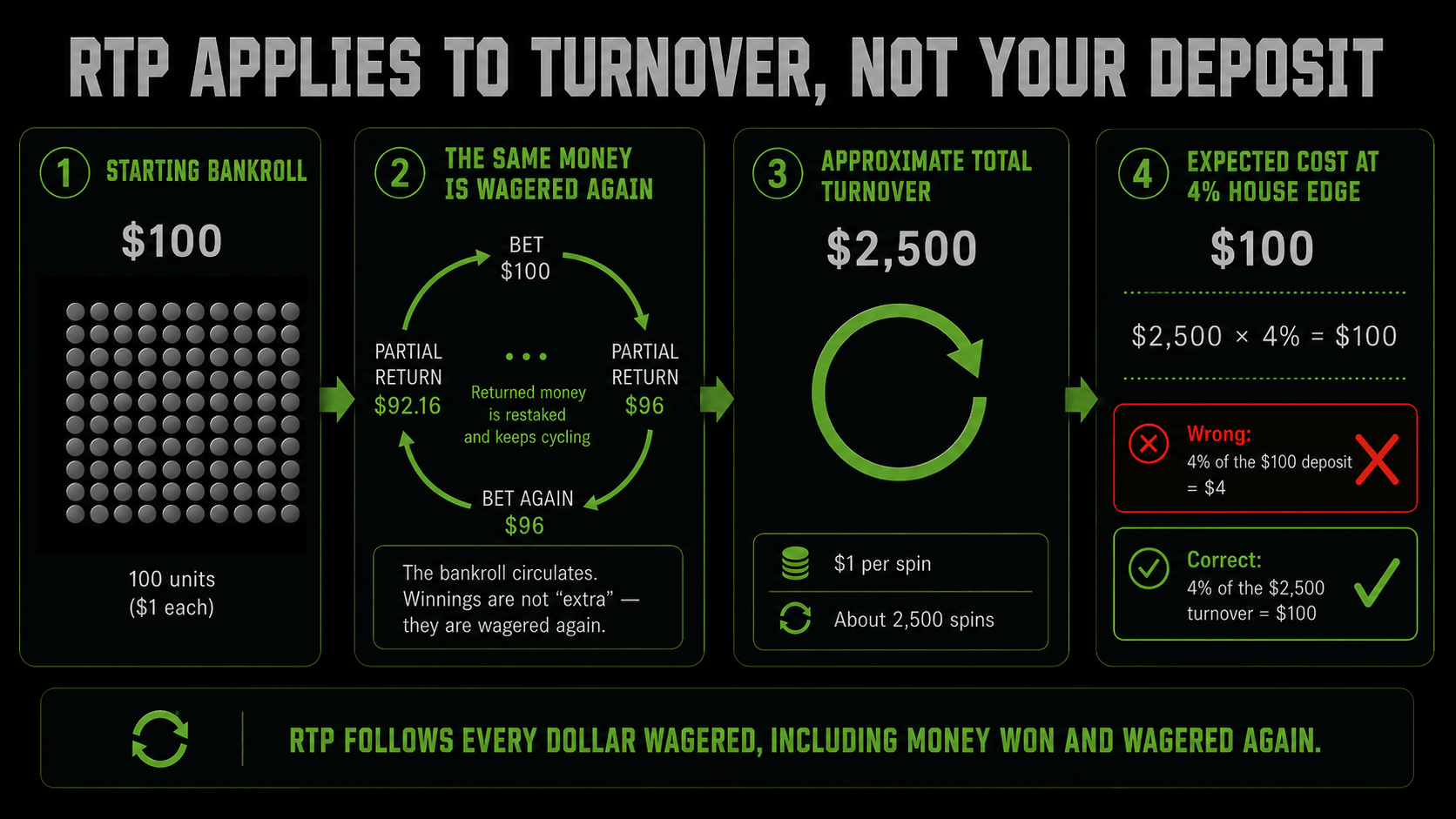
Ask a room what a 96% RTP means for a $100 bankroll and most people will answer that they should expect to get $96 back. That is the wrong denominator, and if you play until the bankroll is gone it understates the damage twenty-five-fold.
RTP applies to turnover, meaning every unit you stake, including units you won and then staked again. At $1 a spin on a 96% game, the expected loss per spin is four cents. A $100 bankroll therefore funds about 2,500 spins before it is gone, and by the time it is gone you will have wagered roughly $2,500. The 4% was taken from that $2,500, not from your $100.
This is also the reason bonus wagering requirements cost far more than they appear to. A requirement to turn over a bonus thirty times is a requirement to expose thirty times that amount to the house edge, and the expected cost scales with turnover rather than with the bonus. Our breakdown of wagering requirements puts numbers on that, and bankroll management covers sizing stakes so that turnover stays survivable.
RTP by game type
The percentages you meet vary far more by game category than most published lists suggest.
Slots carry a legal floor rather than a standard. Nevada requires a theoretical return of no less than 75% on each wager available on a device. New Jersey sets its minimum at 83% under N.J. Admin. Code 13:69E-1.28A. Those are the legal floors, not what anything typically pays, and the distance between a 75% floor and a 96% game is enormous.
Table games are conventionally quoted as house edge, and converting them puts the best of them well above any slot. The free odds bet in craps pays exact true odds, so its RTP is 100.00%, and it is the only bet on a casino floor where that is true. The pass line runs at 98.59%.
Dice games sit high when you back their main bets. Sic bo's Small and Big return 97.22%. Evolution's Lightning Dice publishes 96.03% on essentially every bet, rising to 96.21% on totals of 3 or 18. Super Sic Bo returns 97.22% on Small and Big.
Then there is the answer to a question people actually search for: which slot has a 99% RTP? None of them, reliably. But crypto dice games do, and by design. Stake Dice and the platforms that copied it run a house edge of 1%, which is an RTP of exactly 99%, and it holds at whatever win chance you select because the multiplier is derived from it. The highest advertised return in online gambling is not attached to a slot at all. It belongs to the simplest dice game on the site. Stake Dice explained takes apart the mechanics, and our dice probability charts cover the odds behind every dice bet. For a ranking of games by what they cost, see casino games with the best odds.
Why one game can have many RTPs
Talking about "the RTP of craps" is close to meaningless, because a craps table is not one bet. It is dozens of them at wildly different prices.
| Bet on the same table | RTP |
|---|---|
| Craps free odds | 100.00% |
| Craps pass line | 98.59% |
| Craps place 4 or 10 | 93.33% |
| Craps any 7, single roll | 83.33% |
| Sic bo Small or Big | 97.22% |
| Sic bo total of 9 or 12 | 81.02% |
| Sic bo specific triple at 180 to 1 | 83.80% |
Those are all the same dice, the same throws and the same physics. The spread from 100.00% down to 81.02% comes entirely from what each bet pays relative to its true odds, which means your realised return depends far more on which boxes you back than on which table you sit at. Nothing on the layout tells you the ranking.
Two further things move the published number without changing the game you see.
Progressive jackpots split their return in two. The advertised RTP covers the base game plus a jackpot contribution rate, and the contribution is inside the figure rather than added on top. For standalone progressives that slice is typically 1% to 3% of every wager; for wide-area networks linked across many casinos it can reach 8% or 9%. So a game published at 96% with a 4% contribution returns 92% through ordinary play, and the missing four points exist only for whoever eventually takes the jackpot. Technically accurate, practically misleading for everybody else.
Games with decisions assume you make them perfectly. Blackjack and video poker publish returns that hold only under optimal play, and every deviation lowers the figure you actually get. A dice bet has no such caveat, because there is nothing to play badly.
Where to find a game's real RTP
Four places, in descending order of how much you should trust them.
The game's own information panel is authoritative for the version you are actually playing. Open the rules or paytable inside the game itself and the published return will be stated there.
The operator's game information page is usually accurate and occasionally stale.
Testing laboratory certificates sit behind the whole system. Firms like Gaming Laboratories International verify that a game's theoretical RTP matches its maths before it goes live, and their reports are the reason the number means anything.
Third-party RTP lists are the least reliable, and there is a specific reason why. Providers ship the same game in several RTP configurations, and the operator picks one at integration. Pragmatic Play titles such as Gates of Olympus and Sweet Bonanza are commonly released in three versions, at roughly 96.5%, 95.5% and 94.5%, with identical graphics, features and gameplay. NetEnt, Play'n Go and Red Tiger offer variable settings too, and in some jurisdictions the configuration can be set as low as about 84%. Nothing on screen tells you which version you opened. So a list saying "this game is 96.5%" is describing a version that may not be the one your casino licensed.
Crypto dice sidesteps the question. Instead of publishing a number you have to trust, it lets you verify each roll after the fact against a committed server seed, which is what provably fair systems do.
How to actually use an RTP figure
The number is useful for a narrow set of decisions and useless for the rest, so it helps to know which is which.
Use it to rank bets inside one game. This is where RTP earns its keep, because the comparison is exact and the choice is yours. On a craps table, backing the pass line with free odds instead of scattering single-roll props changes your expected cost by more than fifteen percentage points, and the dice do not care either way.
Use it to compare games of similar volatility. Two low-variance table games at 97% and 98% are genuinely one point apart. A 97% slot and a 97% dice bet are not comparable in any practical sense, because the spread around that figure differs by an order of magnitude.
Do not use it to plan a session. RTP converges over hundreds of thousands of rounds and your session is not one of them. Session planning is a bankroll and volatility question, which is what risk of ruin actually answers.
Do not trust a figure you read anywhere except inside the game. Configurable versions make third-party lists unreliable by construction.
And if the goal is simply to lose as slowly as possible, the arithmetic points somewhere specific. The free odds bet in craps at 100.00% and crypto dice at 99.00% are the two best-priced propositions in gambling, and neither is a slot.
Five things RTP does not mean
It does not mean you get 96 cents back per dollar deposited. It means the game keeps 4% of everything staked, and a bankroll cycles through staking many times over.
It does not describe how often you win. A game can return 96% through frequent small wins or through one enormous payout in fifty thousand spins, and RTP reads the same either way. Frequency lives in volatility.
It does not create a debt the game owes you. A machine sitting below its theoretical return has no mechanism for correcting, because each round is independent of every round before it. That belief is the gambler's fallacy, and RTP gives it a veneer of arithmetic it does not deserve.
It does not become beatable through bet sizing. The percentage applies to each unit staked no matter how you sequence your stakes, which is why no betting system beats the house edge.
And it does not transfer between casinos. The same title can be a different RTP at a different operator, so a figure you read in a review is not a figure you can assume at the table.
FAQ
What does 96% RTP mean?
That over its lifetime, across all players, the game returns 96% of everything wagered on it and keeps 4%. Both figures apply to total turnover, not to deposits, and neither predicts a single session.
Is RTP the same as house edge?
They are the same quantity from opposite ends: RTP = 100% − house edge. A 97.22% return and a 2.78% edge describe one bet.
What counts as a good RTP?
Above 97% is strong for any game, and above 99% is rare enough to be worth seeking out. The comparison only holds within a game type, since a 96% slot and a 96% dice bet deliver that return with very different volatility.
Which game has the highest RTP?
The free odds bet in craps, at 100.00%, because it pays true odds, though it only exists as a supplement to a pass or don't pass bet that already carries an edge. As a standalone game, crypto dice at a 1% house edge gives 99%.
Does RTP apply to my session?
No, and this is the central point. After 1,000 even-money bets your realised return can sit anywhere between about 95% and 102% purely by chance, which is a wider band than the house edge itself.
Who checks that RTP figures are real?
Independent testing laboratories verify a game's theoretical return against its mathematics before regulators approve it, and regulators publish tolerance bands for how far actual results may drift from theory. The UK Gambling Commission allows ±4.91 percentage points at 50,000 games, narrowing to ±1.10 points at a million.