
Expected value is what a bet averages out to. Multiply each outcome by the chance of it happening, add the results, and you have the amount the bet is worth per attempt over the long run.
Most gambling writing stops at the house edge, which is the same idea scaled down to one unit of stake. That scaling is convenient and it costs you something: a percentage tells you what a bet costs but not what a decision costs. Expected value keeps the money in the answer, which is why it can price things a percentage cannot, including a whole session, a bonus offer, a comp, and every betting system ever invented.
What expected value is
The calculation needs outcomes and probabilities, nothing else.
Put $10 on red at a double-zero roulette table. Eighteen pockets pay, twenty do not:
EV = (+$10)(18/38) + (-$10)(20/38) = -$0.5263
The bet is worth minus 53 cents. Make it a thousand times and you will be down about $526, give or take a lot of noise.
The bridge to the house edge runs in both directions. Divide expected value by the stake and you get a rate: $0.5263 on $10 is 5.2632%, the familiar roulette figure. Multiply that rate by everything you wager and you get back to money. Same quantity, different packaging, and the choice of packaging decides which questions you can answer.
Nothing changes when a bet has more than two results, which is worth seeing once because most examples are coin-flip shaped and real layouts are not. The craps field bet pays even money on a 3, 4, 9, 10 or 11, doubles your money on a 2 or a 12, and loses on anything else. Counting the ways two dice can land:
EV = (+$10)(14/36) + (+$20)(2/36) + (-$10)(20/36) = -$0.5556
Fourteen ways to win at even money, two ways to win double, twenty ways to lose, and a bet worth 56 cents less than you put down. Divide by the stake and it is a house edge of 5.56%, which is the figure our house edge table gives for that bet. More outcomes means more terms in the sum and nothing else.
The average is not an outcome
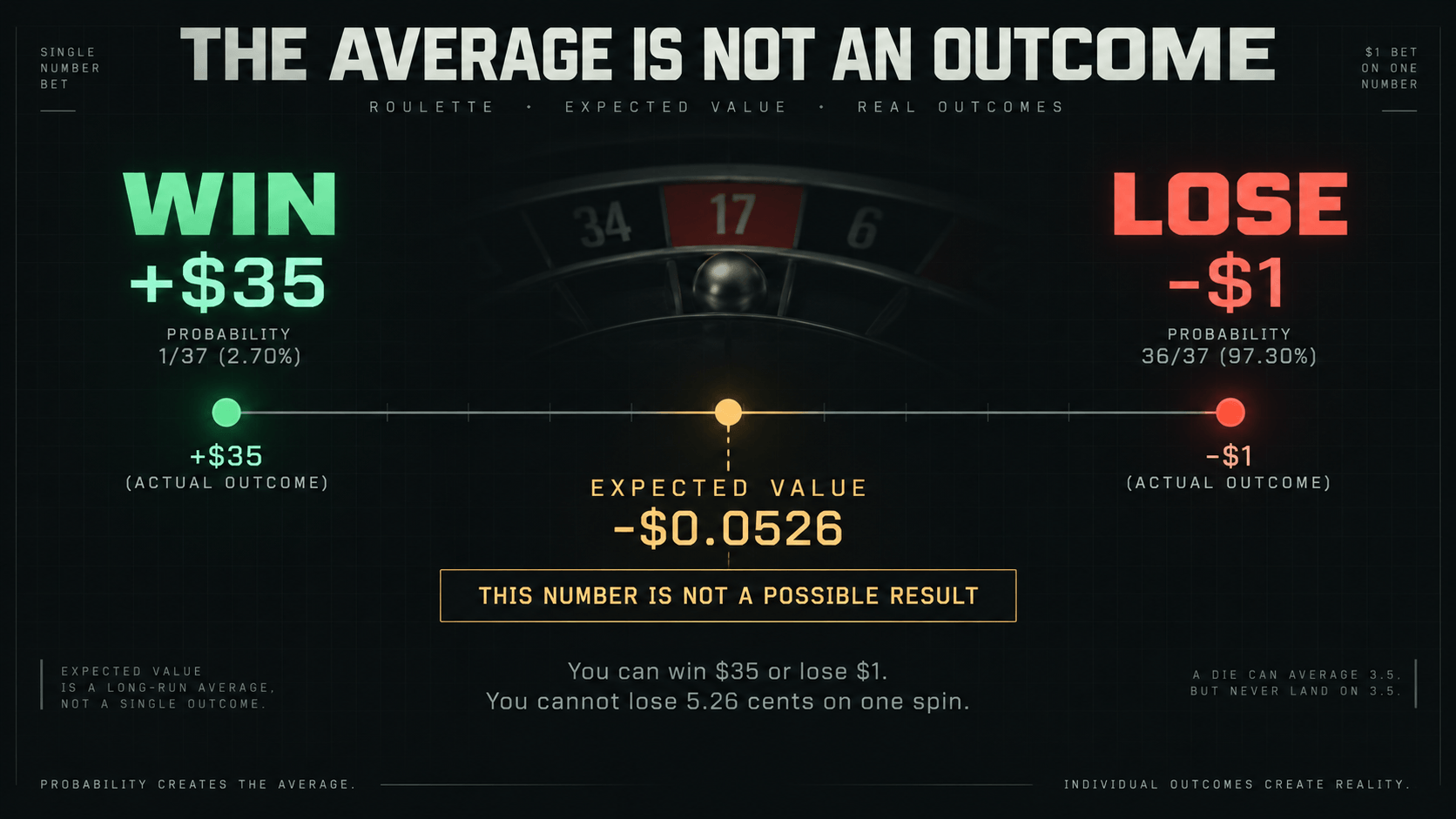
Bet a dollar on a single number. The wheel pays 35 to 1, so you either finish $35 up or $1 down, and the expected value is minus 5.26 cents.
Notice that minus 5.26 cents is not among the things that can happen. It is not an unlikely result, it is an impossible one. Expected value is a property of the distribution rather than a forecast of any trial, in the same way that the average roll of a six-sided die is 3.5 and no die has ever landed on 3.5.
This trips people up in both directions. A negative expectation does not mean you will lose tonight, and a session that finishes ahead does not mean the arithmetic was wrong. Expected value describes what the average converges to, and RTP covers how slowly that convergence actually happens.
Expected values add up
Here is the property that does the real work. The expected value of a sequence of bets is the sum of their expected values, no matter how the stakes are chosen and no matter what order they come in. Bet sizes can depend on previous results. It changes nothing.
That sentence kills every betting system, so it is worth watching it happen.
Take a Martingale on red: bet $10, double after each loss, stop when you win or after six bets. Each step is reached only if every previous one lost, which happens with probability 20/38 each time.
| Step | Stake | Chance of reaching it | Expected amount staked | Expected loss |
|---|---|---|---|---|
| 1 | $10 | 1.00000 | $10.0000 | $0.52632 |
| 2 | $20 | 0.52632 | $10.5263 | $0.55402 |
| 3 | $40 | 0.27701 | $11.0803 | $0.58318 |
| 4 | $80 | 0.14579 | $11.6635 | $0.61387 |
| 5 | $160 | 0.07673 | $12.2774 | $0.64618 |
| 6 | $320 | 0.04039 | $12.9236 | $0.68019 |
Add the columns. The sequence stakes $68.47 on average and loses $3.60 on average, and one divided by the other is 5.2632%.
That is the house edge on a single spin, reproduced exactly by a staking pattern designed to defeat it. Now bet flat: $10 a spin until you have wagered the same $68.47, which takes about seven spins. Expected loss, $3.60. Identical.
The doubling did one thing. It moved money through the table faster on the spins that followed a loss, which changed how much you wagered and left the rate alone. Every progression does the same thing, which is why betting systems fail as a category rather than one at a time, and why the Martingale in particular feels safe right up until the sequence runs long.
What expected value prices that a percentage cannot
House edge describes a bet. Expected value describes anything with outcomes and probabilities attached, which is most of what a casino offers you.
| What you are pricing | What goes in | What comes out |
|---|---|---|
| One bet | stake, payout, win chance | value of the bet |
| A session | average stake, bets per hour, hours, edge | expected cost of the evening |
| A bonus | bonus amount, wagering multiple, game edge | value of accepting it |
| A comp | theoretical loss, comp rate | value of the perk |
| A promotion | its rules, whatever they happen to be | whether it is worth the bother |
The method never changes. Only the thing being weighed does.
A session is the one worth doing by hand, because it is the number people actually want and almost never see. Suppose you bet $10 on the craps pass line for four hours. A pass line player gets through roughly 30 decisions an hour, so that is $1,200 wagered, and at 1.41% the evening has an expected cost of $16.97.
Move one input at a time and you can see which lever matters. Double the stake and the cost doubles to $33.94. Double the hours and it doubles again. Switch to a double-zero roulette wheel, which spins about 40 times an hour, and the same $10 across four hours costs $84.21, five times as much for the same stake and the same evening.
The gap comes from two places at once: the wheel charges nearly four times the rate, and it charges you a third more often. Pace and price multiply, which is the part a percentage on its own will never tell you.
Pricing a bonus
This is where expected value earns its keep, because bonus offers are designed to be read as free money and the arithmetic is not hard.
Take a $100 bonus with a 30 times wagering requirement, played on a game returning 96%. The requirement means you must stake $3,000 before withdrawing. A 4% edge on $3,000 is an expected loss of $120.
EV = $100 – ($100 x 30 x 0.04) = -$20
The offer costs $20 to accept. Run it across a few multiples and the shape appears:
| Wagering requirement | Expected value of the bonus |
|---|---|
| 20x | +$20 |
| 25x | $0 |
| 30x | -$20 |
| 35x | -$40 |
| 40x | -$60 |
The break-even point falls out as a rule you can carry around: a bonus is worth taking when the wagering multiple is below one divided by the house edge.
| Edge of the game you clear it on | Break-even wagering multiple |
|---|---|
| 0.5% | 200x |
| 1% | 100x |
| 2% | 50x |
| 4% | 25x |
| 6% | 17x |
Which explains why casinos exclude or discount the cheap games when a bonus is in play. At half a percent the offer stays positive up to a 200 times requirement, and no operator is handing that out. The fine print of the offer decides which games count at all, and at what fraction.
Pricing comps and theoretical loss
Casinos rate players on exposure rather than results, using a figure the industry calls theoretical loss. Tracked across a player’s visits it becomes average daily theoretical, which every host and pit boss shortens to ADT, and it is the number that decides what you are offered. Both are expected value applied to a person instead of to a bet.
That is why a player who happened to win still gets the room. The rating was set by how much action went through the game, and the result never entered the calculation at all.
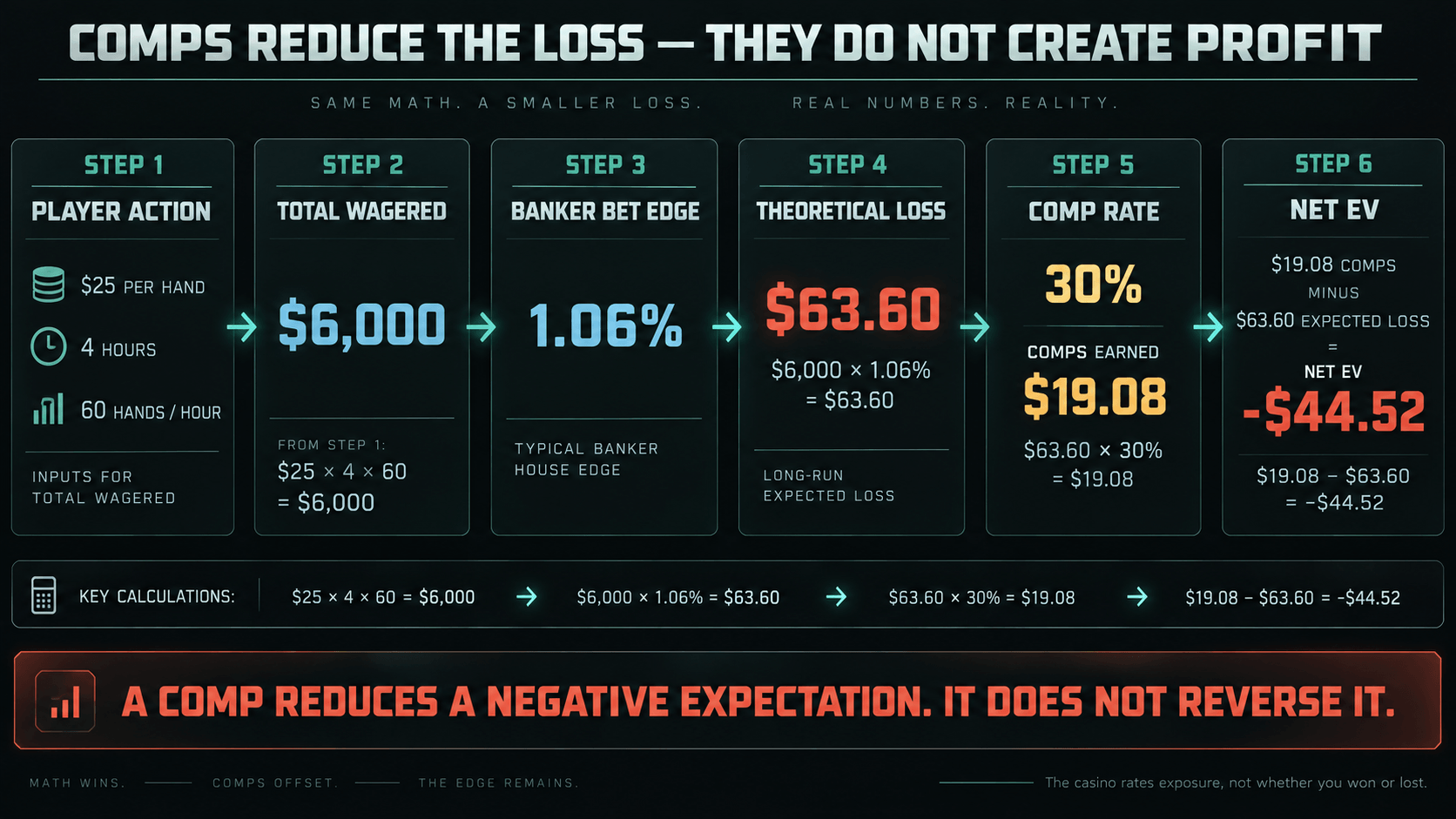
Play $25 a hand of baccarat for four hours at 60 hands an hour. That is $6,000 wagered, and on the banker bet at 1.06% the expectation is a loss of $63.60. Comp budgets are set as a share of that number, so at a 30% rate the player earns about $19.08 in food, drinks and room.
Now put the two together, because that is the part nobody does:
$19.08 of comps – $63.60 of expected loss = -$44.52
The perk is real and it does not turn the evening positive. A comp reduces a negative expectation, and it would take a 100% return rate to reach zero, which is not a rate any casino offers. The useful version of this is comparative: if you were going to play anyway, being rated is strictly better than not being rated, and the casino math reference covers how these figures sit alongside the operator’s own accounting.
Why a casino price cannot be argued with
There is a real difference between casino games and betting markets, and it is not the size of the edge.
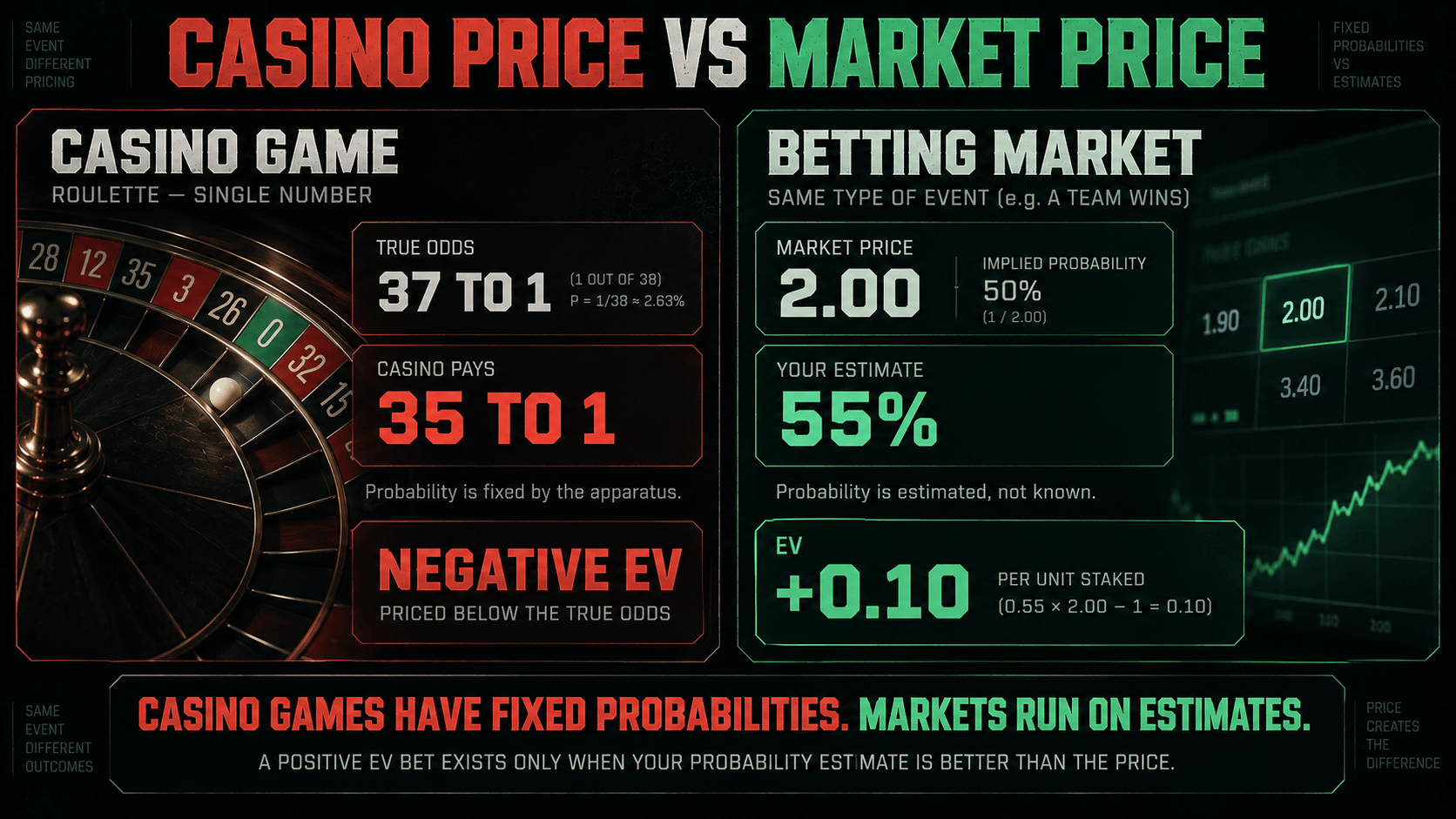
In roulette the probability is a fact about the apparatus. Thirty-seven ways to lose against one to win means the honest payout is 37 to 1, the wheel offers 35 to 1, and no amount of analysis changes either number. You can measure the shortfall exactly, as our odds page does, and then your options are to accept the price or not play.
In a betting market the probability is somebody’s estimate. Take a price of 2.00, which breaks even if the outcome happens half the time. If you think it happens 55% of the time:
EV = (+1)(0.55) + (-1)(0.45) = +0.10 per unit staked
Ten percent in your favour, entirely on the strength of your estimate being better than the one baked into the price. That is what people mean by a positive expected value bet, and the whole idea rests on a probability nobody knows for certain.
Worth being blunt about what that takes in practice. Finding those prices reliably is an industry rather than a technique, built on subscription software that scans live odds across dozens of books, and the edges it surfaces are small and disappear quickly once the market notices. Casino games have no equivalent, because there is no disputed number to have an opinion about.
Where expected value misleads
It says nothing about spread. Flat-betting $10 on the pass line for a thousand decisions has an expected loss of $141.41 against $10,000 wagered. The standard deviation over those same thousand bets is about $316, more than twice the expectation, so finishing a few hundred dollars up after a thousand decisions is an ordinary result rather than a remarkable one. Expected value is the centre of a distribution and tells you nothing about its width. RTP puts figures on that width.
It assumes you survive to collect the average. A sequence with a tolerable expectation is worthless if the bankroll runs out before the long run arrives, which is the subject of risk of ruin.
It does not size your bets. Knowing a bet is worth something does not tell you how much to stake on it, and getting that wrong can lose money on a bet with a genuine edge. The Kelly criterion handles that question.
It is not a prediction. Positive expected value does not promise a win and negative does not promise a loss. It promises a direction, and only over more repetitions than most people will ever play.
So is it worth playing?
Expected value answers this better than any argument about willpower, because it turns the question into a price.
The session calculation above is the whole answer. Seventeen dollars for four hours at the craps table, $84 for the same four hours at a roulette wheel, and several hundred for an evening on keno cards. Those are prices for entertainment, in the same sense that a concert ticket or a restaurant bill is a price.
Read that way the question becomes answerable rather than moral. If the number is one you would happily pay for four hours of something you enjoy, the maths has no further objection. If it is larger than you expected, the lever is not a system or a lucky streak; it is a cheaper game, a smaller stake, or a shorter session, and those three levers are the only ones that exist.
What expected value does rule out is the middle position, where somebody plays a negative-expectation game and expects it to fund something. The arithmetic does not allow that, and it never has.
FAQ
What is expected value in gambling?
The average amount a bet returns per attempt over the long run, found by multiplying each outcome by its probability and adding the results. A $10 bet on red at double-zero roulette has an expected value of minus 53 cents, meaning it costs about that much each time on average, though any individual spin returns $10 or takes $10.
How do you calculate expected value?
Multiply what you win by the chance of winning, multiply what you lose by the chance of losing, and add the two. For a $10 bet on red: $10 times 18/38 gives $4.74, minus $10 times 20/38 gives $5.26, and the difference is minus $0.53.
Is expected value the same as house edge?
They are the same quantity with different denominators. House edge is expected value divided by the stake, expressed as a percentage, so it describes the price of a bet. Expected value keeps the money, so it can also price a session, a bonus or a comp. Our house edge page covers the percentage form in detail.
What is a positive EV bet?
A bet whose expected value is above zero, which requires a price better than the true probability of the outcome. These exist in betting markets, where the probability is an estimate and estimates can be wrong in your favour. On a casino floor they are close to absent by design, since the probability is fixed by the equipment and the payout is set below it. The narrow exceptions are the ones our house edge page lists: the craps free odds bet, which is priced exactly fair, a few full-pay video poker machines played perfectly, and the occasional promotion a casino has costed wrong.
Can a betting system create positive expected value?
No. Expected values add, so a sequence of negative-expectation bets has a negative expected value regardless of how the stakes are arranged. Systems change how much money passes through the game and how the wins and losses are distributed, and neither of those touches the rate. The proof covers the general case.