
Casino math is the set of calculations that determine what a gambling game costs to play. Every bet on a casino floor has a price, that price is fixed by the rules before anyone sits down, and a handful of formulas are enough to work it out for almost any game.
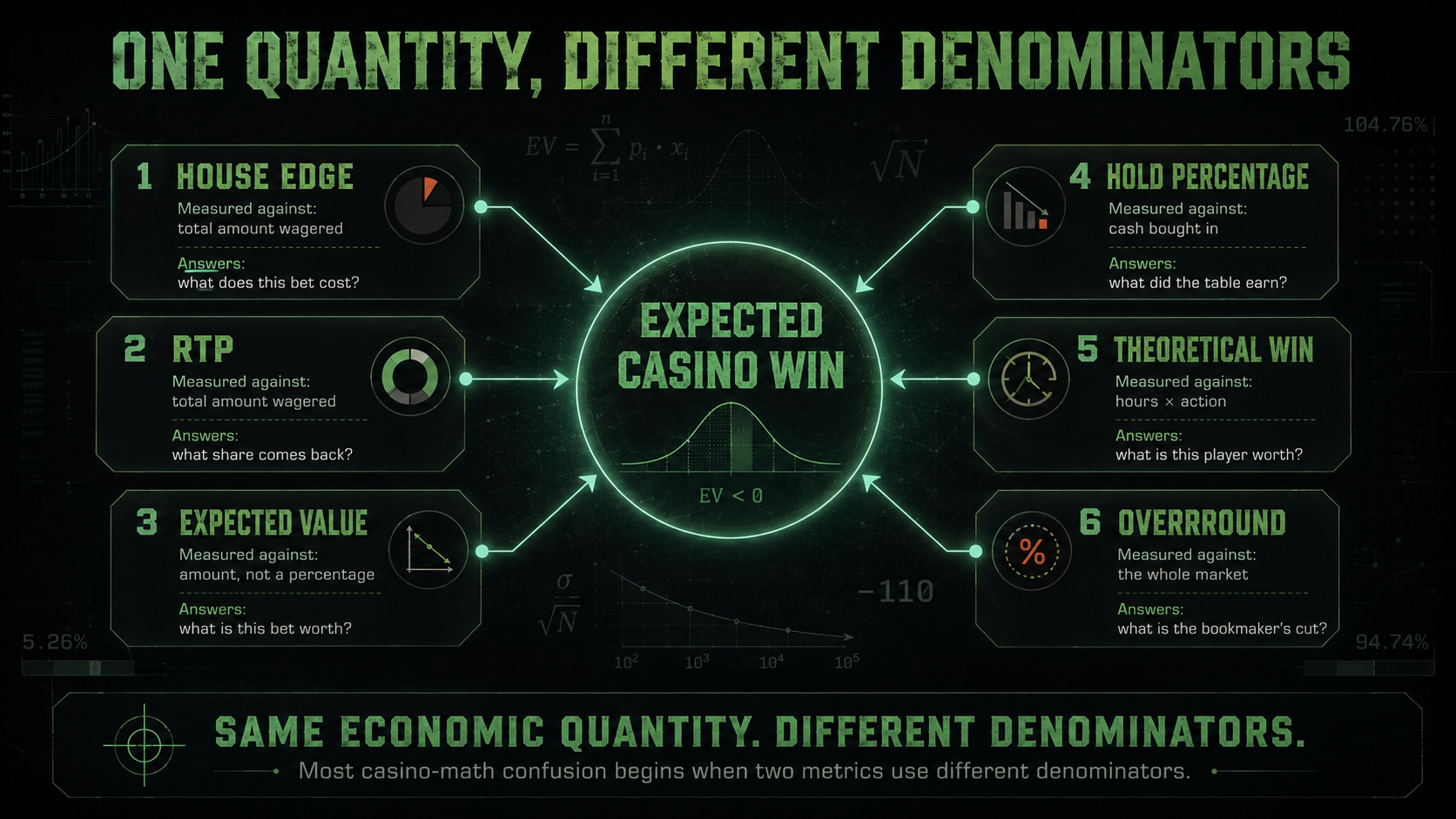
There are fewer formulas than the subject’s reputation suggests. Most of them compute the same quantity, which is the money the house expects to keep. What separates them is the denominator: whether that money is measured against what you wagered, what you bought in for, how long you played, or how many bets you have resolved. Nearly every argument about casino math comes down to two people using the same word for two different denominators.
This page holds the formulas, one worked number for each, and links to the full treatment where one exists.
One quantity, several denominators
| Metric | Measured against | Answers | Full treatment |
|---|---|---|---|
| House edge | Total amount wagered | What does this bet cost? | Below |
| RTP | Total amount wagered | What share comes back? | RTP |
| Expected value | Nothing, it is an amount | What is this bet worth? | Below |
| Hold percentage | Cash bought in | What did the table earn? | Below |
| Theoretical win | Hours at the table | What is this player worth? | Below |
| Overround | The whole market | What is the bookmaker’s cut? | Reading odds |
| Standard deviation | The number of bets resolved | How far from expected can this land? | Below |
The second column is the one that causes arguments. House edge and hold percentage get quoted for the same game and come out several times apart, and neither figure is wrong.
House edge and RTP are one number written twice
Expected value is the starting point. Multiply each outcome by its probability, add the results, and you have the average value of one bet.
A single number in double-zero roulette pays 35 to 1 and hits once in 38 spins:
EV = (+35)(1/38) + (-1)(37/38) = -0.0526
Stake a dollar and you lose 5.26 cents on average. Flip the sign and express it as a percentage of the stake and you have the house edge: 5.26%. Subtract that from 100 and you have the return to player: 94.74%. Slot makers publish the second number, table games quote the first, and the two carry identical information.
The same calculation runs on any bet whose outcomes you can count. It gets harder when strategy affects the result, which is why blackjack and video poker edges come out of simulations rather than a line of arithmetic, but the definition never changes.
A published house edge is not a single number
Look up the house edge for a game and you will often find two figures. Both are usually correct.
Let It Ride is the clearest case. A player puts up three equal bets of one unit and may pull two of them back, so the money that stays at risk averages about 1.22 units rather than three. Quote the edge against the one-unit base bet and it is 3.51%. Quote it against the 1.22 units actually wagered and it is 2.86%. Both describe the same loss of three and a half cents a hand at one-dollar units. The same split appears in Caribbean Stud (5.22% against 2.56%), Three Card Poker (3.37% against 2.01%), Casino War (2.88% against 2.68%) and Red Dog (2.80% against 2.37%).
A second split comes from ties. Baccarat’s banker bet costs 1.06% if you count only decided hands and 1.17% if you count every hand dealt. The player bet runs 1.24% against 1.37%, and the don’t pass bet in craps 1.36% against 1.40%.
Robert Hannum, whose UNLV guide is the standard reference for these conventions, puts the resolution plainly: whichever representation you choose, the expected win is the same. The figures differ because the denominators differ, not because anyone is rounding differently.
So check that two published edges are measured the same way before deciding one game is cheaper. At Let It Ride’s ratio of money at risk, a 3.51% quoted against the base bet costs less per hand than a 3.00% quoted against everything wagered.
The casino’s ledger: handle, drop, win and hold
Players think in terms of house edge. Casino accounting departments cannot, and the reason is mundane.
| Term | What it counts |
|---|---|
| Handle | Every dollar wagered, including winnings staked again |
| Drop | Cash and markers exchanged for chips at the table |
| Win | What the casino actually kept |
| Hold percentage | Win divided by drop |
| Actual win percentage | Win divided by handle |
| House advantage | The value actual win percentage settles toward |
A dealer cannot record every bet from every seat across a shift, so handle at a table game goes uncounted. What can be counted is the cash that goes into the locked box under the table, and performance gets measured against that instead. This one accounting constraint is behind most of the confusion around casino percentages.
Hannum puts Nevada’s roulette hold at roughly 24%. The house edge on a double-zero wheel is 5.26%. Both figures describe the same game and neither is a typo.
The reconciliation is arithmetic. A hold of 24% against an edge of 5.26% implies that the average buy-in is wagered about 4.6 times before the player leaves. Chips won on one spin get bet on the next, and each pass through the wheel is charged 5.26%. The casino never keeps a quarter of the money bet on roulette. It keeps a quarter of the money brought to the table, which is a different sentence.
Run it forward with your own numbers. Buy in for $500, bet $25 a hand, play four hours of blackjack at 60 hands an hour. You have wagered $6,000. At a 0.5% edge the house expects to win $30, which is 6% of your buy-in. A 0.5% game, a 6% hold, one session.
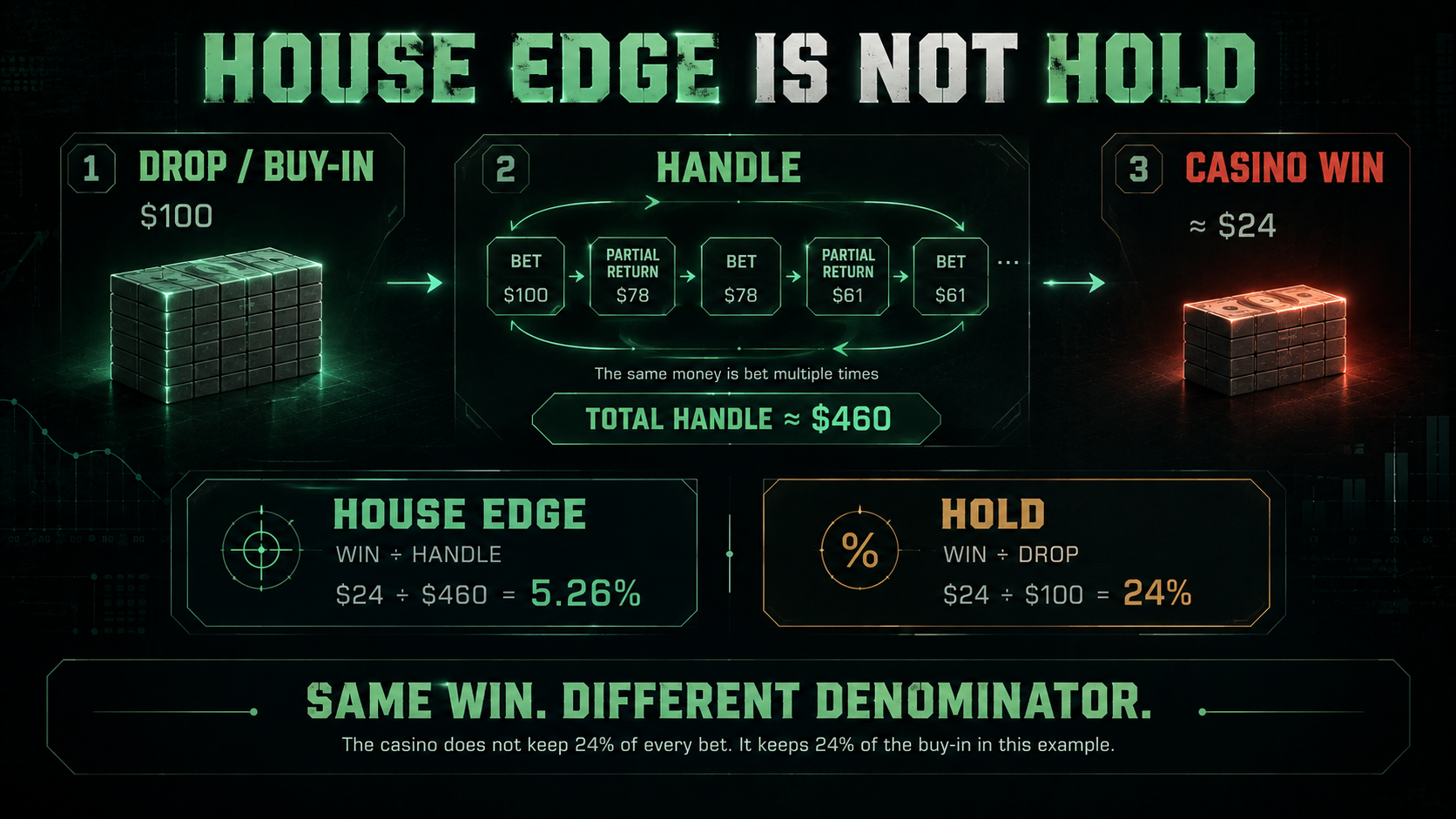
Hold percentage therefore tells you how a pit performed. It tells you nothing about what a game charges, and comparing it against a house edge produces nonsense. The distinction does collapse on slot machines, because the machine records every wager, so hold and win percentage come out the same, and that is a large part of why the terms get used interchangeably. For the business logic behind these numbers, see how casinos make money.
Theoretical win, and what the casino thinks you are worth
Comps are not generosity and they are not calculated from your losses. They come from a formula:
Theoretical win = average bet x hours played x decisions per hour x house advantage
A baccarat player betting $500 a hand for 12 hours at 60 hands an hour, against a 1.2% edge, is worth $4,320 to the casino. Move that player to a double-zero roulette wheel at 5.3% and the same bet size, the same hours and the same pace produce $19,080.
Two things follow. The first is that a casino rates you on exposure rather than outcome, so a player who wins is rated identically to a player who loses and receives the same comp. The second is that game choice moves the number more than anything else you control: the roulette player above generates over four times the value of the baccarat player without wagering a dollar more.
Casinos set comp budgets as a share of theoretical win. At a rate of 30%, that baccarat player rates about $1,296 in room, food and beverage. This calculation is also the reason the industry tracks average daily theoretical, usually shortened to ADT: it is this formula applied across a player’s visits. Expected value covers the player-side version of the same arithmetic.
Standard deviation, and why it decides what you experience
House edge tells you the price. It says nothing about whether you will notice paying it, and over any realistic number of bets that second question dominates.
For a bet with two outcomes, the standard deviation of a single wager is:
SD = sqrt( p(win – EV)^2 + (1-p)(loss – EV)^2 )
Over N independent bets it grows with the square root of N. The craps pass line makes a clean example, because its standard deviation on one bet works out to almost exactly 1.000 unit. Across 1,000 bets the standard deviation is 31.6 units while the expected loss is 14.1. Applying the usual confidence bands, 95% of thousand-bet runs finish somewhere between 49 units ahead and 77 units behind, and virtually all of them between 81 ahead and 109 behind.
Now watch what happens as the count grows.
| Bets resolved | Expected loss | Standard deviation | Expected loss as % | SD as % |
|---|---|---|---|---|
| 100 | 1.4 units | 10.0 units | 1.414% | 9.999% |
| 1,000 | 14.1 units | 31.6 units | 1.414% | 3.162% |
| 10,000 | 141.4 units | 100.0 units | 1.414% | 1.000% |
| 100,000 | 1,414.1 units | 316.2 units | 1.414% | 0.316% |
| 1,000,000 | 14,141.4 units | 999.9 units | 1.414% | 0.100% |
Both halves of that table describe the same bet, and they point in opposite directions. Measured as a percentage, results converge on the house edge, which is the law of large numbers doing what everyone says it does. Measured in money, the gap between expected and possible outcomes grows without limit. The longer you play, the more certain the rate becomes and the less predictable the amount.
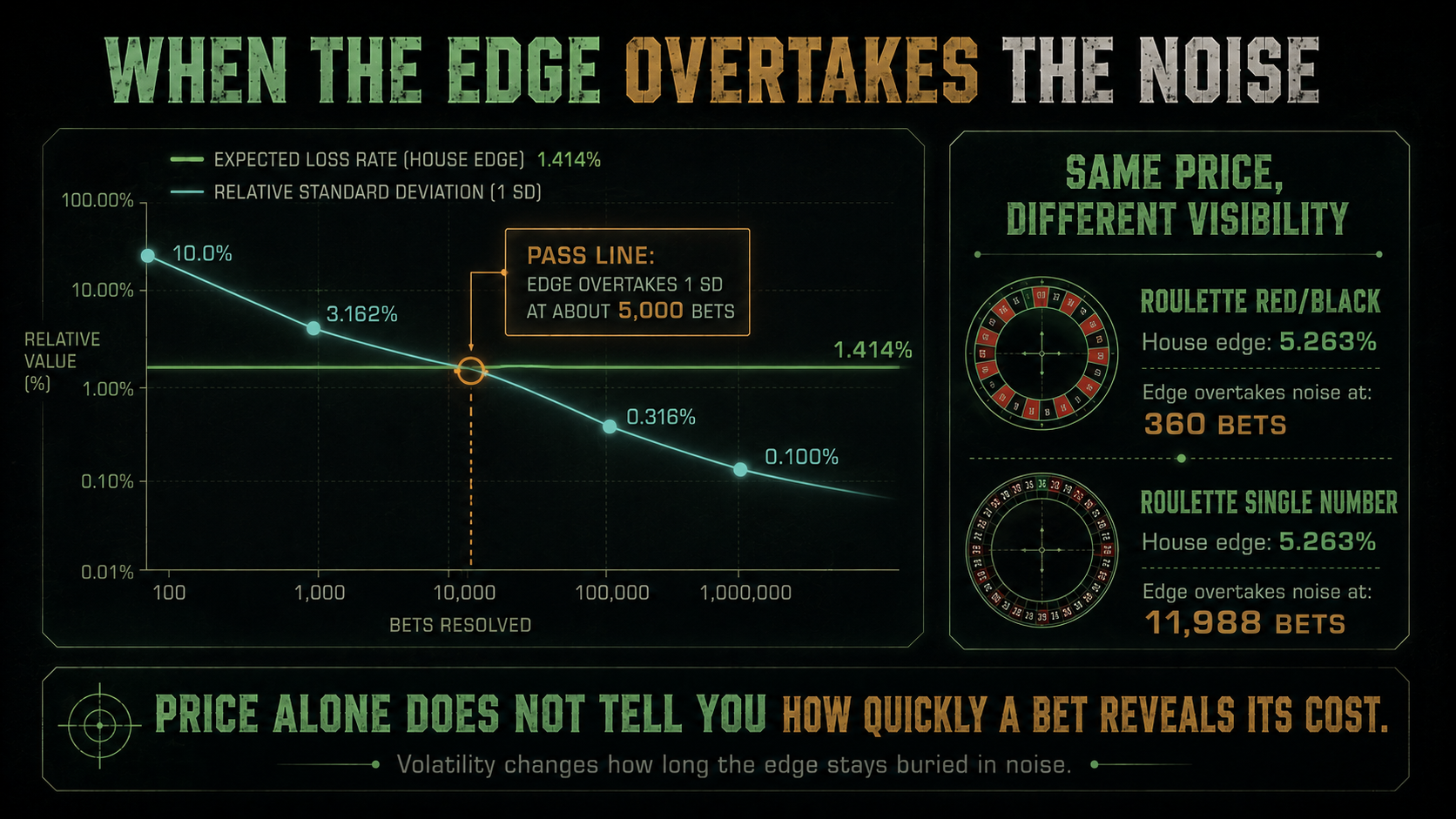
The crossover matters more than either column. Set expected loss equal to one standard deviation and solve for N, and you get the point where the edge stops being buried in noise:
| Bet | House edge | SD per bet | Edge overtakes noise at |
|---|---|---|---|
| Craps any 7, pays 4 to 1 | 16.667% | 1.863 | 125 bets |
| Roulette red or black, double zero | 5.263% | 0.999 | 360 bets |
| Roulette single number, double zero | 5.263% | 5.763 | 11,988 bets |
| Craps pass line | 1.414% | 1.000 | 5,000 bets |
The two roulette rows are the point of the table. Same wheel, same 5.263% edge, and one of them takes 33 times as many spins to show it. Price alone does not decide how long a bet can hide its cost, because the crossover depends on the square of the ratio between volatility and edge. A small edge pushes it out, and so does a wild payout structure, which is why the cheapest bet here is not the slowest to reveal itself.
The practical reading is that no session measures a game. It also explains why the shape of these distributions drives risk of ruin, and RTP works the same convergence problem in percentage terms.
One caution about the table above. Those four bets pay a fixed amount on a single event, so their distributions are exact. Blackjack, video poker and most slots pay several different amounts on one wager, and their standard deviations have to be computed from the full payout distribution rather than a two-outcome formula.
Vig and overround: the same margin on a two-sided market
Sportsbooks charge the same way casinos do, but the margin sits inside a pair of prices rather than a single payout.
Convert every price in a market to implied probability and add them:
Overround = sum of implied probabilities – 1
A spread priced at -110 on both sides implies 52.38% per side. The two sides total 104.76%, so the overround is 4.76 percentage points, and the book keeps 4.55% of the money matched on the market. The practical form of that number is a break-even threshold: at -110 you need to win 52.38% of your bets to finish level, not half of them.
That is the same mechanism as a roulette wheel paying 35 to 1 on a 37 to 1 shot, expressed in the vocabulary of a different industry. Reading odds works through the formats and the conversion, and implied probability covers turning any price into a percentage.
True odds, and the gap that pays for everything
True odds are the payout that would make a bet break even forever: the ratio of losing outcomes to winning ones.
A single number on a double-zero wheel wins once and loses 37 times, so the honest price is 37 to 1. The wheel pays 35 to 1. That missing two units, spread across every spin, is the entire business.
Every commercial bet has this shape. Someone establishes the true odds, offers slightly less, and lives on the difference. In games built from a countable set of outcomes the calculation is exact, which is why dice probability can price a craps layout to the last decimal. In sports the true odds are somebody’s estimate, so you cannot check a single price against them. The overround survives that problem, because summing both sides of a market reveals the margin without needing to know the real probabilities at all. If you want the outcome of this comparison rather than the method, casino games with the best odds ranks them.
The formula sheet
| Formula | Written out | Worked example |
|---|---|---|
| Expected value | Sum of (payoff x probability) | $5 on red, double-zero roulette: loses $0.263 |
| House edge | Negative EV per unit wagered | Single number, double zero: 5.26% |
| RTP | 100% minus house edge | 5.26% edge: 94.74% |
| True odds | Losing outcomes to winning outcomes | Single number, double zero: 37 to 1 |
| Implied probability | 1 divided by decimal odds | -110: 52.38% |
| Overround | Sum of implied probabilities minus 1 | Two sides at -110: 4.76 points |
| SD, one bet | sqrt of the probability-weighted squared deviations | Craps pass line: 1.000 unit |
| SD, N bets | SD of one bet x sqrt(N) | 1,000 pass line bets: 31.6 units |
| Hold percentage | Win divided by drop | Nevada roulette: about 24% |
| Actual win percentage | Win divided by handle | Settles toward the house edge |
| Theoretical win | Average bet x hours x decisions per hour x edge | $500 baccarat, 12 hours: $4,320 |
| Kelly fraction | (bp – q) divided by b | Negative for every bet above |
That last row is worth a sentence. The Kelly criterion sizes a bet against the size of your edge, and it returns a negative fraction whenever the edge belongs to the other side. Applied to any bet in this article it says to stake nothing, which is mathematically correct and beside the point for anyone gambling for entertainment. It becomes useful only in the rare situations where a player genuinely holds an edge.
What these formulas will not do
They price a game, not a session. Expected value describes an average across a number of trials most players will never reach, and the tables above show how far a real session can sit from it in either direction.
They also describe the game rather than the play. Basic strategy holds a six-deck blackjack game to about 0.5%, but Hannum notes that the average player gives up around 2% through mistakes and departures from strategy. The published figure is a floor available to someone playing correctly, not a description of what happens at the table.
And no formula on this page says anything about the next result. Every calculation here is a statement about a distribution. The wheel has no memory of the numbers behind it, and nothing in the arithmetic gets more true because a result is overdue.
FAQ
What math is used in gambling?
Probability and basic statistics cover most of it. You need the ability to count outcomes, weight them by probability to get an expected value, and take a square root to get a standard deviation. Games where decisions affect the outcome, such as blackjack and video poker, need combinatorial analysis or simulation, which is why their edges are published rather than derived at the table.
Is hold percentage the same as house edge?
No, and the difference is large. House edge is expected win divided by the total amount wagered. Hold percentage is actual win divided by the cash bought in, and buy-ins get wagered several times over. Nevada roulette holds about 24% against a 5.26% edge. On slot machines the two converge, because the machine counts every wager.
What is theoretical win?
The amount a casino expects to win from a specific player, calculated as average bet times hours played times decisions per hour times the house edge. It sets comp entitlements, and it is based on how much action a player gives rather than how much that player lost. Averaged over a player’s visits it becomes average daily theoretical, or ADT.
Why do two sources give different house edge figures for the same game?
Usually because they use different denominators. An edge can be quoted per hand or per unit wagered, and it can include or exclude ties. Both figures describe the same expected win. Check which convention a source uses before comparing its number to another one.
Does the math mean a player always loses?
Over enough bets, yes, for every wager in this article. Over a session, no, and the standard deviation table shows why: at a thousand pass line bets the noise is more than twice the size of the edge. The formulas make the long-run outcome certain and leave the short-run outcome genuinely open, which is the arrangement the entire industry is built on.