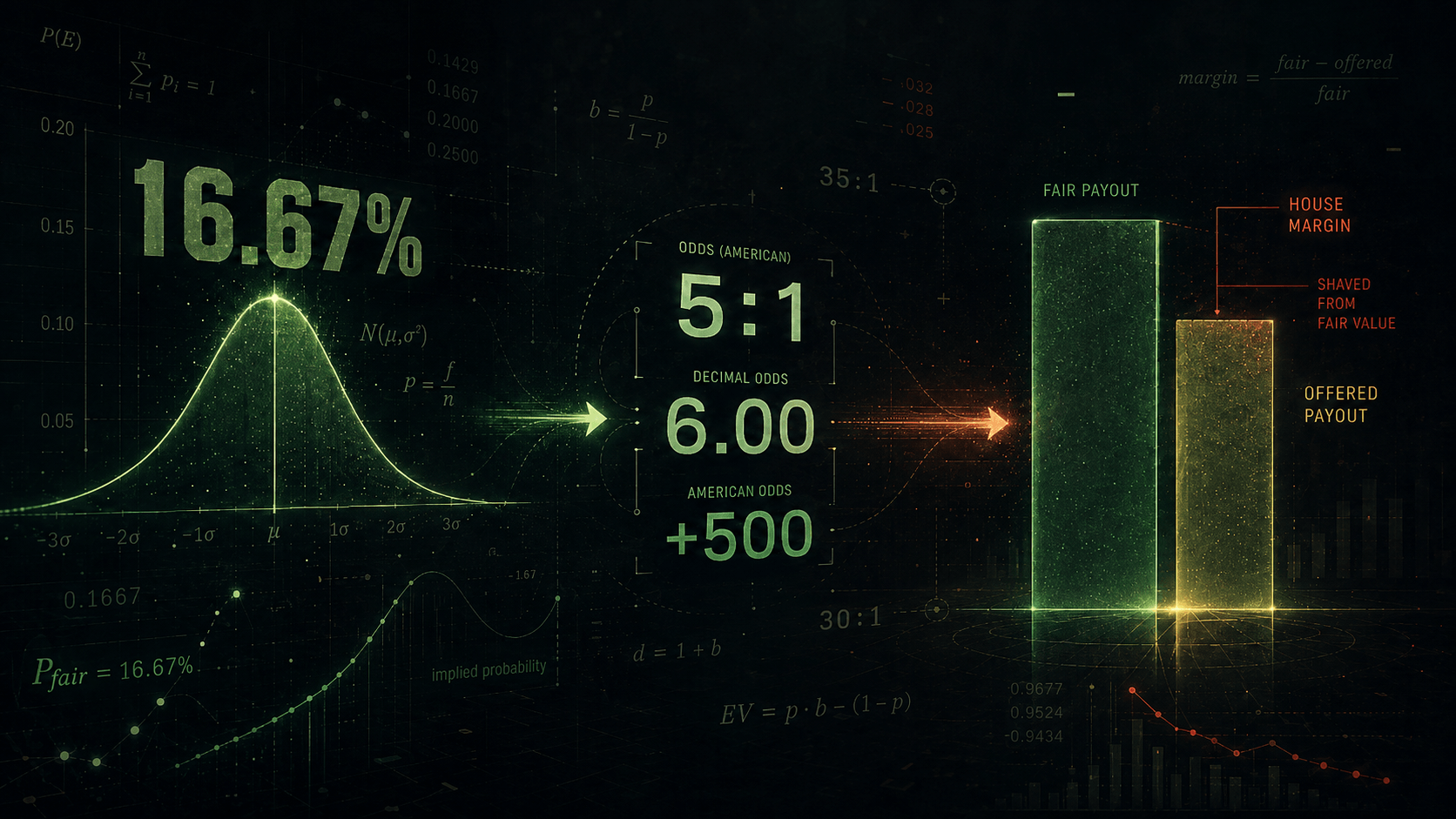
Odds are a price. They tell you what a bet pays, not how likely it is to win, and the whole gambling industry lives in the distance between those two things.
Probability is a property of the event. Odds are a number someone chose to offer you for it. When those two line up exactly, the bet is a coin flip in the economic sense and nobody profits. They almost never line up.
This guide covers what an odds figure is, how it relates to probability, how to read all three formats including negative American lines, and what separates a fair price from a bad one. The worked examples come from dice, for a reason that becomes clear about halfway down: dice are the simplest game in which the honest price can be worked out exactly, which makes the gap between honest and offered easy to see.
What an odds figure actually is
An odds quote is a ratio between what you can win and what you must stake. Nothing more.
"5 to 1" means five units of profit for every one unit risked. Stake $10, win $50, and you get $60 back counting your stake. It does not mean one chance in five. That confusion is the single most common error in reading odds, and it costs people money.
Odds quoted this way are odds against: the first number is bigger, and the outcome is less likely than not. When the outcome is more likely than not, the ratio flips and you get odds on, written as something like 1 to 2, meaning you risk two to win one. The break point between them is evens, or 1 to 1, where you win exactly what you stake.
That break point sits at a 50% chance, which gives you a quick sanity check on any price. Anything longer than evens is a bet the market thinks will lose more often than it wins. Anything shorter is a favourite.
Odds are not probability
The two are related but they are not the same measurement, and mixing them up is how people talk themselves into bad bets.
Probability counts outcomes: the share of all possible results that go your way, always between 0 and 1. Odds compare two quantities: the ways you lose against the ways you win. A single number on a European roulette wheel has a probability of 1 in 37, and odds against of 36 to 1, because there are 36 losing pockets for every winning one.
The reason gambling uses odds instead of probability is practical rather than mathematical. Odds are already denominated in money. A price of 5 to 1 tells a cashier what to pay without anyone converting anything. Probability tells you about the world; odds tell you about the transaction.
Every odds quote does carry a probability inside it, though, and that hidden figure is the one worth extracting. It is called implied probability, and it is what the price would mean if the bet were perfectly fair. Our guide to implied probability works through the conversion arithmetic step by step. For reading purposes, the table in the next section gives it to you directly.
The three formats, and how to read any number you see
Three notations, one meaning. Which one you meet depends on where you are: fractional in the UK and in horse racing, decimal across Europe and in most online casinos, American in US sportsbooks.
| Fractional | Decimal | American | Implied probability | $10 stake returns |
|---|---|---|---|---|
| 1/5 | 1.20 | -500 | 83.33% | $12.00 |
| 1/2 | 1.50 | -200 | 66.67% | $15.00 |
| 4/5 | 1.80 | -125 | 55.56% | $18.00 |
| 1/1 | 2.00 | +100 | 50.00% | $20.00 |
| 6/5 | 2.20 | +120 | 45.45% | $22.00 |
| 3/2 | 2.50 | +150 | 40.00% | $25.00 |
| 9/5 | 2.80 | +180 | 35.71% | $28.00 |
| 2/1 | 3.00 | +200 | 33.33% | $30.00 |
| 5/2 | 3.50 | +250 | 28.57% | $35.00 |
| 3/1 | 4.00 | +300 | 25.00% | $40.00 |
| 7/2 | 4.50 | +350 | 22.22% | $45.00 |
| 4/1 | 5.00 | +400 | 20.00% | $50.00 |
| 9/2 | 5.50 | +450 | 18.18% | $55.00 |
| 5/1 | 6.00 | +500 | 16.67% | $60.00 |
| 10/1 | 11.00 | +1000 | 9.09% | $110.00 |
| 30/1 | 31.00 | +3000 | 3.23% | $310.00 |
| 35/1 | 36.00 | +3500 | 2.78% | $360.00 |
Fractional odds show profit against stake. Decimal odds show the total return per unit, which is why they are always one higher than the fractional figure: 5/1 becomes 6.00 because the 6.00 includes your stake coming back.
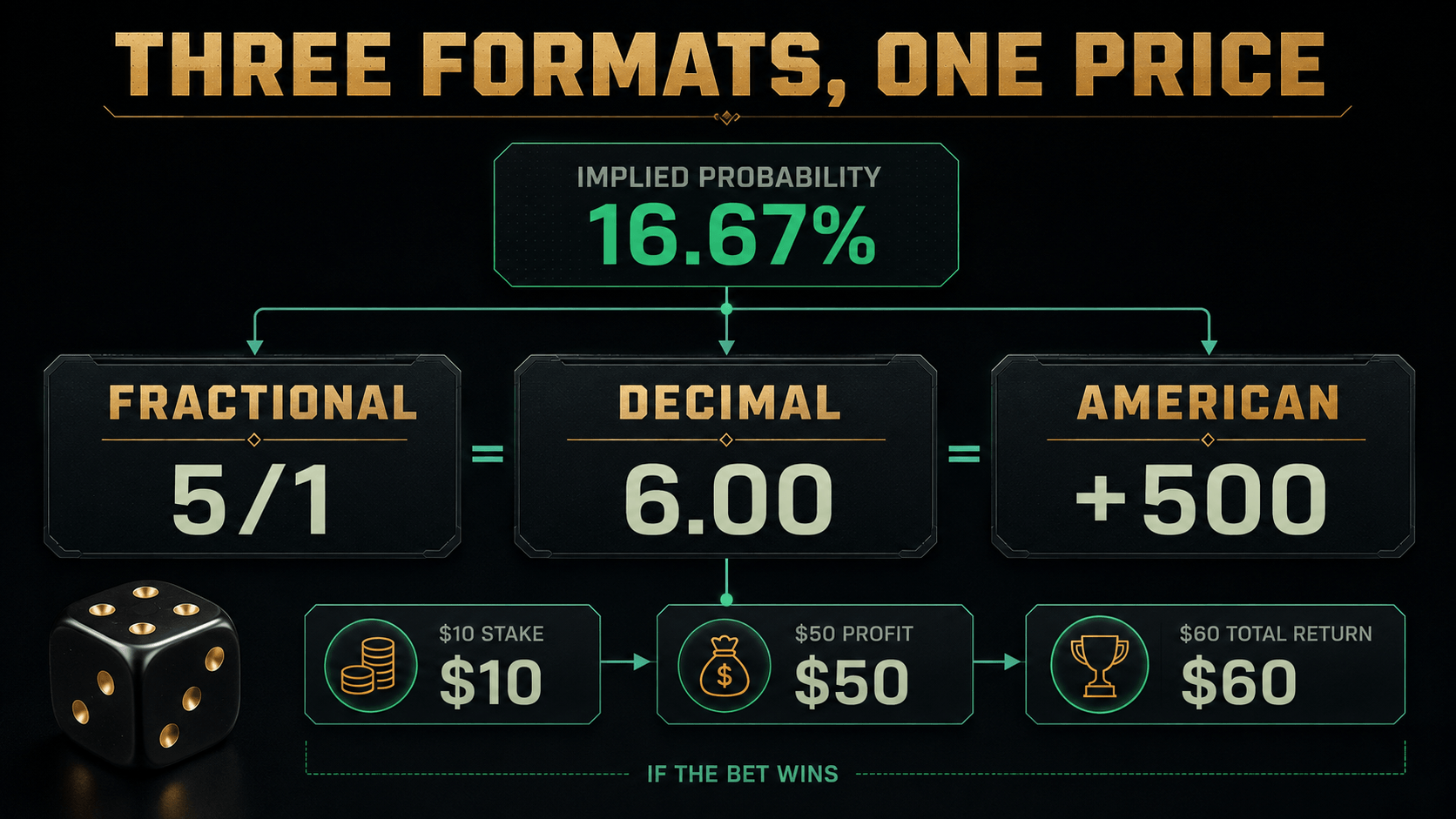
Decimal is the easiest format to compare quickly, since a bigger number always means a longer shot.
Negative American odds
American odds split at 100 and run in two directions, which is where most of the confusion lives.
A positive number is the profit on a $100 stake. At +250 you risk $100 to win $250.
A negative number reverses it: it is the stake required to win $100. At -200 you must risk $200 to win $100. Same information, expressed from the other end, and used whenever the outcome is a favourite.
| American | Decimal | Implied probability | $100 stake returns |
|---|---|---|---|
| -110 | 1.909 | 52.38% | $190.91 |
| -125 | 1.800 | 55.56% | $180.00 |
| -150 | 1.667 | 60.00% | $166.67 |
| -200 | 1.500 | 66.67% | $150.00 |
| -500 | 1.200 | 83.33% | $120.00 |
So -200 is not a mysterious quantity. It is 1/2 in fractional, 1.50 in decimal, and a 66.67% implied chance. The format changed; the price did not.
"To one" and "for one" are not the same
This one is printed on casino felt and almost nobody notices it.
A bet that pays 2 to 1 gives you two units of profit and returns your stake, so you collect three units in total. A bet that pays 2 for 1 gives you two units in total and the casino keeps the stake, so your profit is one unit. Identical-looking notation, half the profit.
The conversion is simply one step: "8 for 1" is the same payout as "7 to 1". Whenever you see "for", subtract one to get the odds-against figure you are used to.
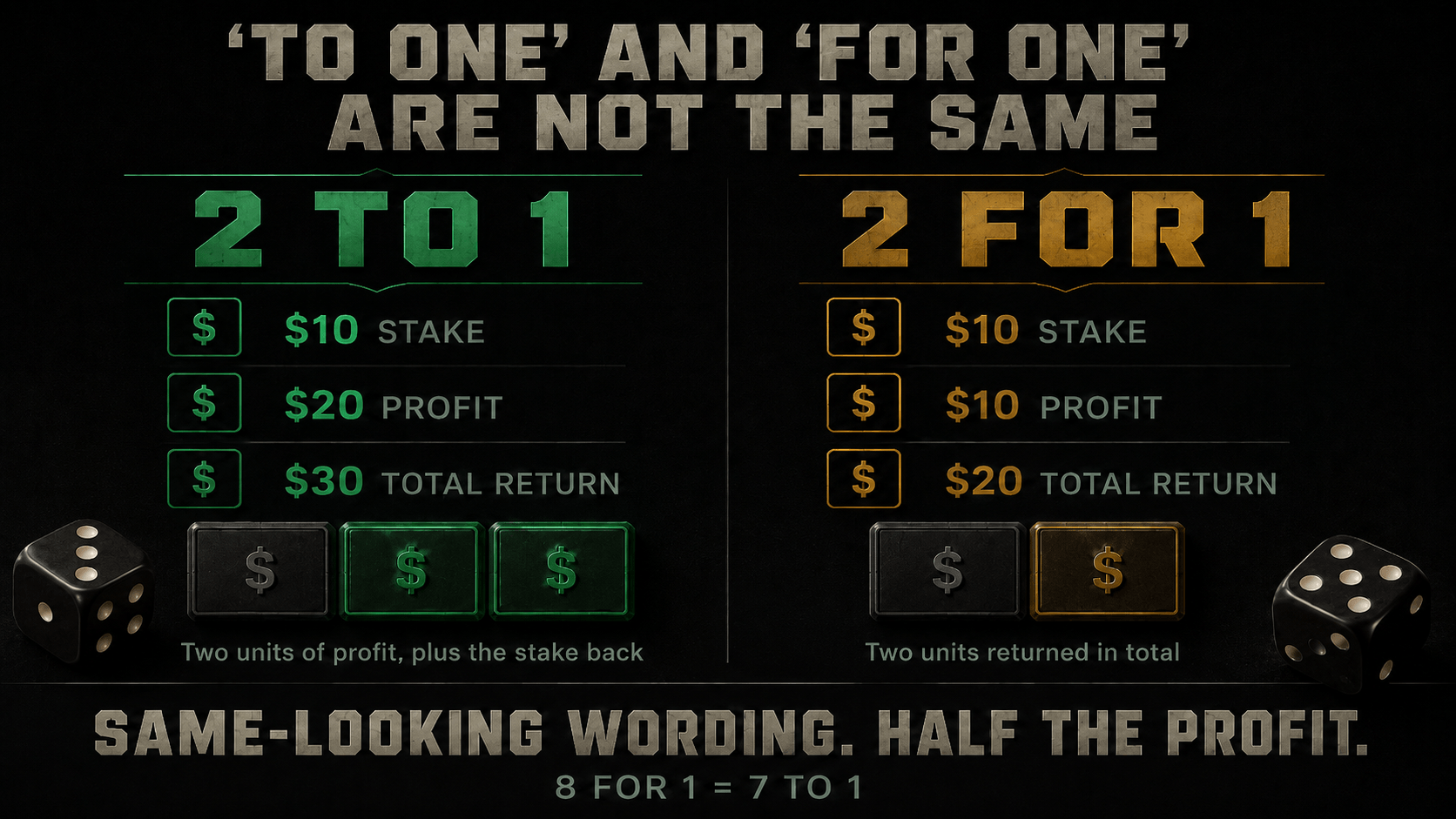
Casinos print the word explicitly on the layout for exactly this reason, and both appear in real games. Sic bo and craps proposition areas use both conventions depending on the house. It is worth a two-second look before you back anything, because a bet advertised as "30 for 1" is really 29 to 1, and that difference is entirely at your expense.
The fourth format: multipliers in crypto dice
Online dice games quote a fourth thing that nobody calls odds, though that is exactly what it is.
In a crypto dice game you choose your own win chance and the interface shows a payout multiplier. That multiplier is decimal odds under a different name: it already includes your stake, so 2.0000x and decimal 2.00 mean the same collection.
What makes it useful for learning is that the house edge sits right on the surface. These games run a 1% edge, so the multiplier is calculated as 99 divided by your win chance, while the fair decimal price would be 100 divided by it:
| Win chance you set | Multiplier offered | Fair decimal odds | Shortfall |
|---|---|---|---|
| 49.5% | 2.0000x | 2.0202 | 0.0202 |
| 33.0% | 3.0000x | 3.0303 | 0.0303 |
| 25.0% | 3.9600x | 4.0000 | 0.0400 |
| 10.0% | 9.9000x | 10.0000 | 0.1000 |
| 2.0% | 49.5000x | 50.0000 | 0.5000 |
Every multiplier is exactly 99% of the fair price, at every chance you can select. That flat 1% haircut is the clearest illustration of pricing you will find anywhere in gambling, and it is why crypto dice is a good place to see the mechanic in isolation.
Why high odds feel backwards
In ordinary English, "high odds of rain" means rain is likely. In gambling it means the opposite, and people arrive at this topic genuinely confused about which way round it goes.
The mechanical answer settles it. An odds figure is a payout multiplier, not a measure of confidence. Payouts get bigger precisely when outcomes get less likely, because the bookmaker or the casino has to compensate you for a worse chance. So high odds means unlikely and well paid; low odds means likely and poorly paid.
Which answers the question people usually mean to ask: the lower the odds, the more likely the outcome. Read the implied probability column above from the bottom up and you can see it without doing any arithmetic. At 10/1 the chance is 9.09%; at 1/2 it is 66.67%.
What that does not tell you is which bet is better. A likelier bet is not automatically a better-priced one, and that distinction is the rest of this page.
What true odds are, and why the price is never them
True odds are the honest price: the ratio that exactly matches the real chance of the outcome, so that betting at it neither gains nor loses money over time.
Take a single number in European roulette. There are 37 pockets, one wins, 36 lose, so the true odds against are 36 to 1. A game paying 36 to 1 on that bet would break even forever. The wheel pays 35 to 1, and that missing unit is the entire business model: a house edge of 2.703%.
That is the shape of every commercial bet. Somebody computes or estimates the true odds, then offers you slightly less, and the shortfall is their income. It carries different names in different places. Casinos call it the house edge. Slots invert it and call it RTP. Sportsbooks call it the vig. The arithmetic underneath is identical.
Which means the only question that matters when you look at a price is not "will this win" but "how far is this from true odds". And that question is usually unanswerable, because in most gambling you cannot compute the true odds at all. Nobody knows the real probability that a particular team wins a particular match. The bookmaker's number is an estimate with a margin baked in, and you have no independent figure to check it against.
Why dice are the best place to learn this
Mechanical casino games are the exception to that, and dice are the clearest of them.
A pair of six-sided dice has exactly 36 equally likely outcomes. That is not an estimate or a model. It is a count, and it means the true odds of every dice bet are knowable to the last decimal before anyone puts money down. Roulette shares the property, as does any game built on a fixed, countable set of results, but nothing is easier to verify than two dice: you can write out all 36 outcomes on a napkin and check the house yourself.
So dice is the easiest place to lay the offered price beside the honest one and read the difference directly.
| Dice bet | True odds against | Typical payout | House edge |
|---|---|---|---|
| Craps free odds on 6 or 8 | 6 to 5 | 6 to 5 | 0.000% |
| Craps place 4 or 10 | 2 to 1 | 9 to 5 | 6.667% |
| Craps 2 or 12, single roll | 35 to 1 | 30 to 1 | 13.889% |
| Sic bo any triple | 35 to 1 | 30 to 1 | 13.889% |
| Craps any 7, single roll | 5 to 1 | 4 to 1 | 16.667% |
The top row is remarkable and worth knowing about: the free odds bet in craps pays exactly true odds, which makes it the only bet on a casino floor with a house edge of zero. It exists only as a supplement to a pass or don't pass bet that already carries an edge, so the casino still makes money on the pair, but the odds portion itself is priced honestly.
Now look at the bottom row. Any 7 pays 4 to 1 on a 5 to 1 shot, which strips 16.667% out of every stake.
Judging these by likelihood instead of price would mislead you. Any 7 wins 16.667% of the time and the free odds bet on 6 wins 45.455%, so here the safer bet happens to be the honest one too. That alignment is a coincidence: place 4 or 10 wins 33.333% of the time, far more often than any 7, and still costs 6.667%.
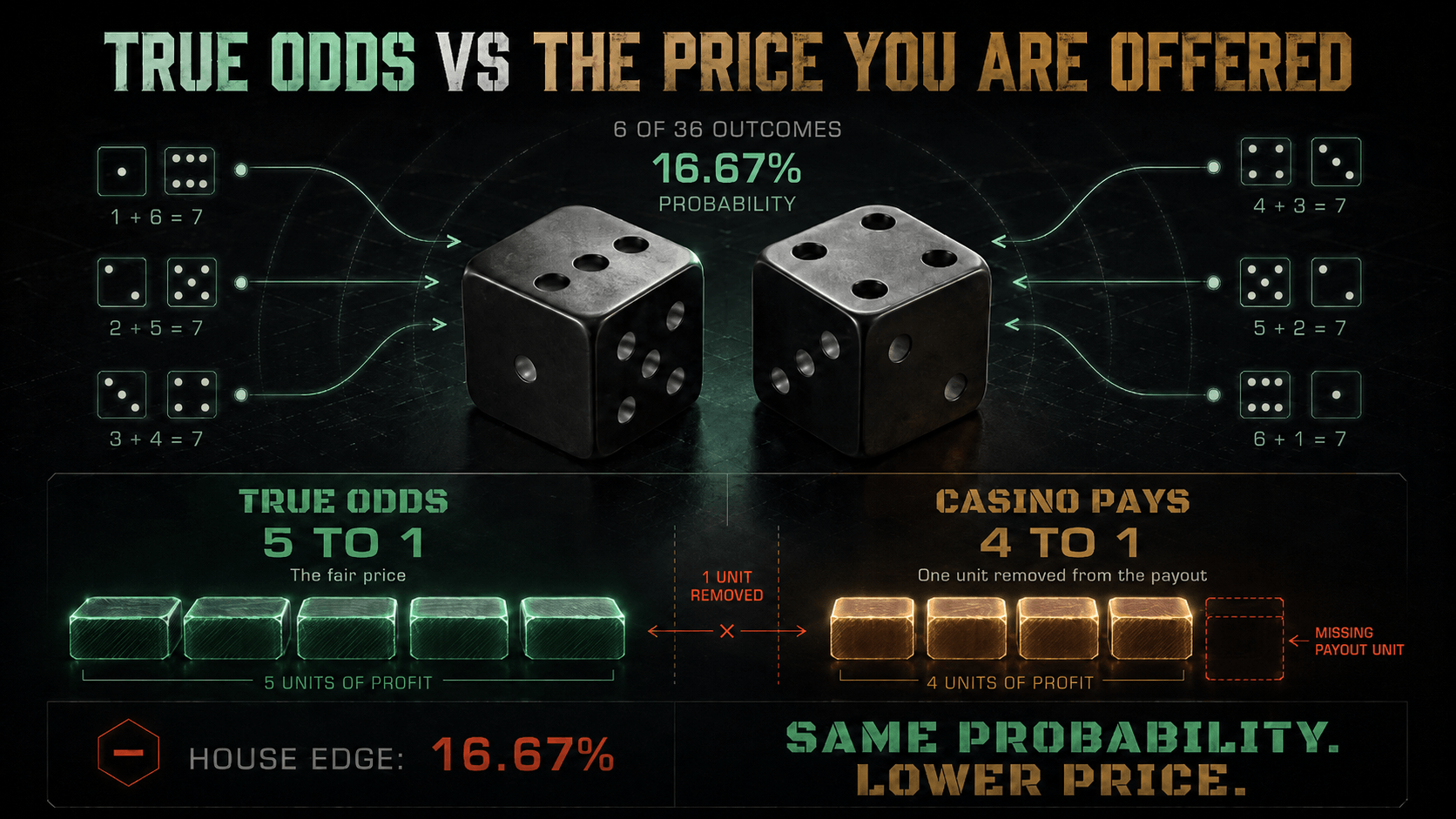
Same dice, same physics, prices ranging from perfect to predatory. Our dice probability charts give the true odds for every combination, which is all you need to price any dice bet yourself.
Why both sides add up to more than 100%
Here is a test you can run on any two-way market. Convert both sides to implied probability and add them.
A typical American football spread is priced at -110 on each side. From the table above, -110 implies 52.38%. Two sides at 52.38% total 104.76%, and probabilities of a complete set of outcomes cannot exceed 100%. The extra 4.76 points are not a mistake. They are the margin, known as the overround.
The practical consequence is a break-even threshold. At -110 you need to win 52.38% of your bets just to stand still, not 50%. Anyone betting coin flips at that price loses steadily, which is the sportsbook version of exactly what the roulette wheel does by paying 35 to 1 instead of 36.
Odds terms in one place
| Term | Meaning |
|---|---|
| Odds against | Payout ratio larger than the stake, so the outcome is less likely than not |
| Odds on | Payout ratio smaller than the stake, so the outcome is more likely than not |
| Evens | 1 to 1, a 50% implied chance, win exactly what you stake |
| Favourite | The outcome with the shortest odds in a market |
| Underdog | Any outcome priced longer than the favourite |
| Longshot | An outcome at very long odds and a very small chance |
| Implied probability | The chance a price corresponds to, found from the odds |
| True odds | The price that exactly matches the real chance, giving no edge to either side |
| House edge | The share of each stake a casino keeps by paying below true odds |
| Overround | The amount by which a market's implied probabilities exceed 100% |
| Vig | The sportsbook's margin, the same idea as overround |
FAQ
Is 2:1 odds good?
It pays $2 profit per $1 staked and implies a 33.33% chance. Whether it is good depends entirely on whether the real chance is better than 33.33%. At exactly 33.33% it is a fair bet, above that it favours you, below that it favours the house.
What does 7 to 2 odds mean?
Three and a half units of profit per unit staked. That is 4.50 in decimal, +350 in American, and a 22.22% implied chance. A $10 bet returns $45.
How good are 10-1 odds?
They pay ten times your stake in profit and imply a 9.09% chance, so the outcome is expected to lose about ten times for every once it wins. Long odds are not generous by themselves; they are compensation for a small chance.
What does +200 mean?
Profit of $200 on a $100 stake. It equals 2/1 fractional, 3.00 decimal, and 33.33% implied.
What do odds of -200 mean?
The reverse direction: you stake $200 to win $100. That is 1/2 fractional, 1.50 decimal, and a 66.67% implied chance, so the outcome is a clear favourite.
Which odds are more likely to win?
Lower ones. Odds and probability move in opposite directions, so a 1/2 shot at 66.67% wins far more often than a 10/1 shot at 9.09%. Winning more often is not the same as being worth backing, which depends on how the price compares with true odds.