Dice sort two ways. By the number of faces, which gives you everything from a two-sided coin substitute to a hundred-sided sphere. And by how the die is built, which is the difference between a toy and an instrument you can bet real money on.
For gambling, the second classification matters far more than the first. Every serious money game on a casino floor runs on the same six-sided cube, and the reason has nothing to do with tradition.
This guide covers the standard polyhedral formats, the odd side counts most people never see, the construction standards that separate casino dice from the ones in a board game box, the crooked variants built to beat them, and the online dice that aren't physical objects at all.
The six-sided die: what gambling actually runs on
The cube is the only shape that gets everything right at once. It has six identical square faces, every one equivalent to every other under rotation, so fairness follows from symmetry rather than from careful tuning. It also happens to be the easiest solid to machine to a tight tolerance and the easiest to read across a table at a glance.
Standard d6 numbering puts opposite faces in pairs that sum to 7: 1 opposite 6, 2 opposite 5, 3 opposite 4. That arrangement gives a quick integrity check, since any legitimate die shows two faces summing to 7 on any opposite pair. Because 1, 2 and 3 meet at a single corner, they can be placed around it two ways. Counter-clockwise makes the die right-handed, clockwise makes it left-handed. Western dice, casino stock included, are right-handed; Chinese dice are normally left-handed. Two dice of opposite handedness are mirror images and roll identically, so the distinction is a manufacturing convention rather than an advantage.
Almost every dice game played for money uses this one format and differs only in how many you throw:
- Craps: two dice, betting on sums and combinations
- Sic bo and chuck-a-luck: three dice
- Cee-lo: three dice, street rules
- Poker dice: five dice with card faces instead of pips
If you want the odds each of those produces, the full probability charts cover one to six dice.
The polyhedral family
Beyond the cube, five more shapes give genuinely fair results because they are isohedral: every face is interchangeable with every other under the solid's own symmetry, so no face can be favoured.
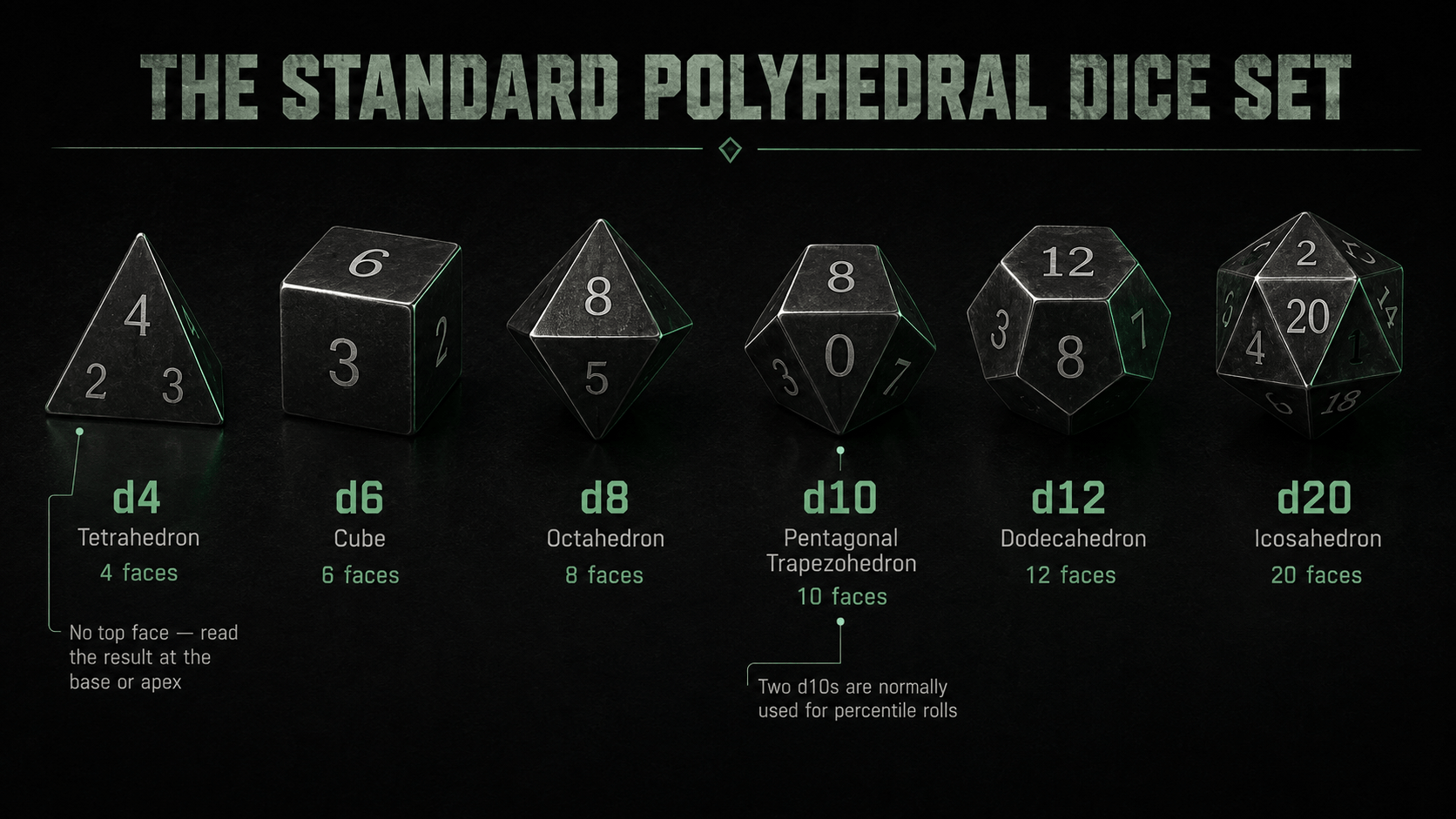
| Die | Solid | Faces | How it reads |
|---|---|---|---|
| d4 | Tetrahedron | 4 | No top face when it lands, so the result is read from the base or the apex |
| d6 | Cube | 6 | Top face |
| d8 | Octahedron | 8 | Top face |
| d10 | Pentagonal trapezohedron | 10 | Top face, numbered 0 to 9 or 1 to 10 |
| d12 | Dodecahedron | 12 | Top face |
| d20 | Icosahedron | 20 | Top face |
| d100 | Two d10s, or a Zocchihedron | 100 | One d10 for tens, one for units |
The d4 is the awkward one. A tetrahedron has no face parallel to the surface it lands on, so there is no top to read, and manufacturers solve it by printing numbers at the corners or repeating them along each edge.
Percentile results usually come from two ten-sided dice rather than a hundred-sided one. One die supplies the tens digit and the other the units, which is cheaper, more reliable and far easier to read than any single d100.
Every one of these is mathematically fair, and none of the non-cubic ones ever reaches a regulated casino table. Two reasons drive that. Casino dice games are built on sums of six-sided dice, so the paytables, the layouts and the regulations all assume a d6. And the more complex the solid, the harder it is to machine to a verifiable tolerance and the harder for a dealer to confirm at a distance that nothing has been swapped. A cube can be checked with a straight edge and a glance. An icosahedron cannot.
Unusual and non-standard dice
Side counts exist well outside the standard set: d2, d3, d5, d7, d9, d14, d16, d24, d30, and up to d120. Most are made either as barrel and prism shapes, or as rounded solids that approximate a sphere with a set number of resting positions.
There's a catch, and it's the most interesting thing about this whole category. No Platonic solid or trapezohedron has nine faces, so a nine-sided die can't be fair by symmetry the way a d6 or d10 is. Manufacturers build one as a truncated sphere with nine resting positions, tuned so that each comes up roughly equally often. It works in practice and it isn't numerically balanced. The same applies to most odd side counts: fairness becomes an empirical result of tuned geometry rather than a guarantee. That distinction is exactly why money games stayed with the cube.
A d3 is usually just a d6 with each number printed twice. A d2 is a coin in die form, or a d6 marked with three ones and three twos.
The Zocchihedron is the oddest object in the family. Lou Zocchi patented a genuine hundred-sided die in the 1980s: a sphere roughly the size of a ping-pong ball with 100 small faces spaced across its surface. It rolls for a long time and it settles unpredictably, which is why the two-d10 method won.
Two more variants change the numbers rather than the shape. Averaging dice are six-sided but marked 2, 3, 3, 4, 4, 5, with opposite faces still summing to 7, which strips out the extreme results and tightens the spread. Sicherman dice are a pair of differently numbered six-sided dice that produce exactly the same distribution of sums as a normal pair, which is a genuinely surprising piece of mathematics.
Then there are dice with no numbers at all. Faces carry letters, symbols, directions or colours depending on the game. The gambling example worth knowing is the poker die: six faces showing 9, 10, jack, queen, king and ace, five of them thrown to build a poker hand.
Precision dice: how a casino die is different
This is the dividing line that matters if money is involved, and it has nothing to do with the number of faces.
An ordinary die has rounded corners and pips drilled into the surface as small recesses. Both features bias it. Rounded edges let it keep rolling in ways that favour some faces, and hollow pips remove material unevenly, so the 6 face ends up lighter than the 1 face.
Casino dice fix both. Edges are cut square and sharp, so the die stops rather than rolling on. Pips are drilled out and then backfilled with material of the same density as the body, so every face weighs the same and the surface finishes flush. Nevada regulations require the result to be a true cube to within 0.0005 inches, about 0.013 mm. A standard casino die measures 3/4 inch per side and weighs roughly 14 grams, which is noticeably heavier and harder than anything in a board game box.
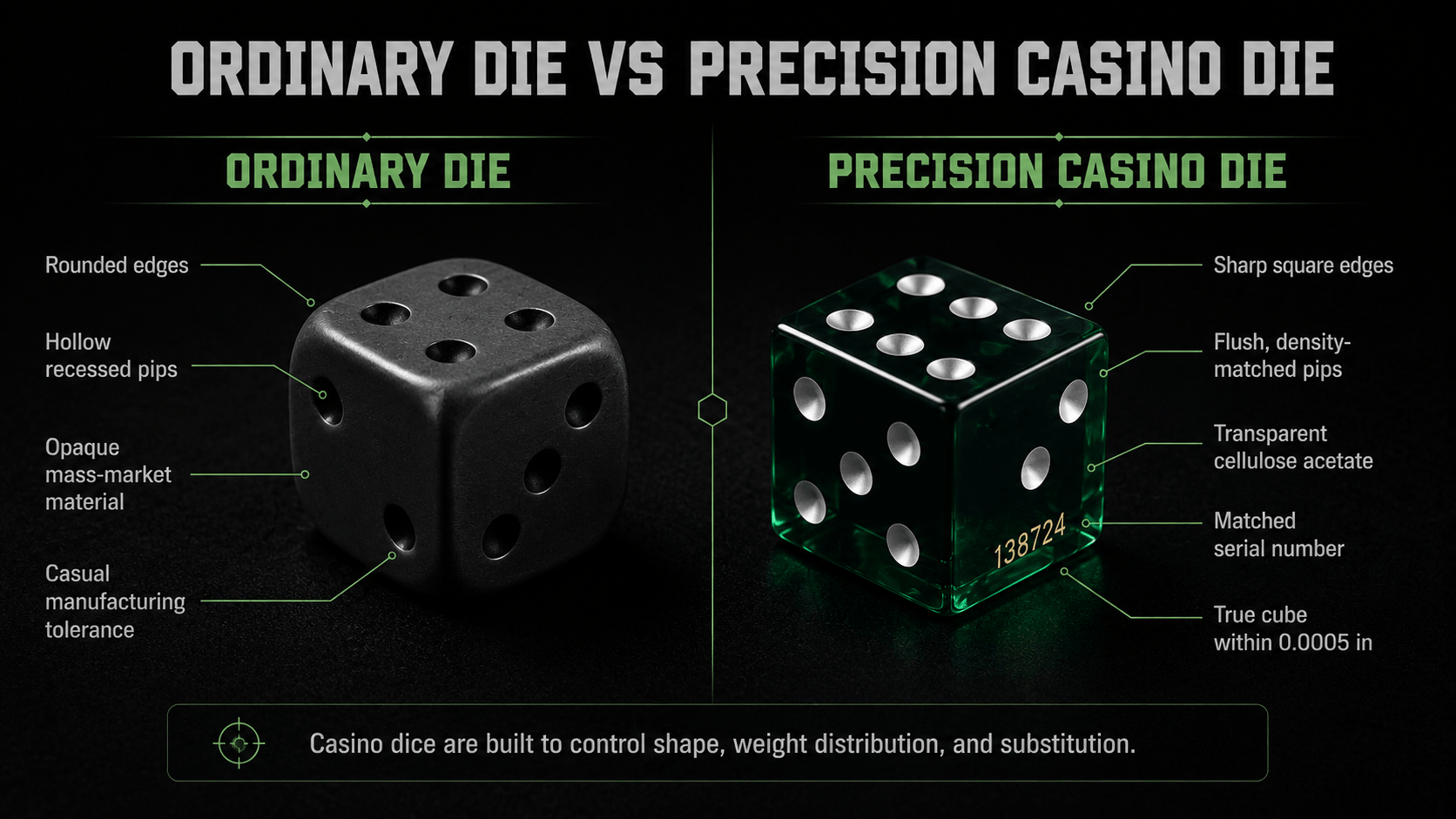
The material is transparent cellulose acetate, and the transparency is a rule rather than a style choice: you can see whether anything has been inserted. Dice are made in matched sets called sticks, each carrying the same serial number, so a die that arrives from a player's pocket doesn't match. Tables rotate dice out within hours, often at shift change, because edges wear and surfaces pick up oil from handling. Retired dice are cancelled before they leave: Nevada casinos generally mark them, while Atlantic City requires a hole drilled straight through.
Our page on casino dice goes deeper on the regulations, and standard dice sizes covers the dimensions across formats.
Loaded and gaffed dice
Crooked dice are a category of their own, and the trade splits them into inside work and outside work.
Inside work means altering the weight. A loaded die has material added or removed internally, usually so the opposite face lands upward more often than chance allows. It's the version everyone has heard of and the easiest to detect, since transparent stock makes an insert visible and a suspect die can be dropped in water to see how it settles.
Outside work means altering the shape, and it's subtler. Flats are shaved on one axis so the die is slightly brick-shaped rather than cubic, which favours the two larger faces. A die with the 1 or 6 face shaved is called a six-ace flat. Bevels round one or more faces very slightly. Cut-edge and razor-edge dice combine a sharp edge that grabs the felt with rounded edges that let the roll continue.
Mis-spotted dice change the numbers instead. Tops and bottoms, also called busters, carry duplicate numbers so that certain sums become impossible and others double up. Because you only ever see three faces at once, a well-made pair is hard to catch by eye. Percentage dice are the professional version: only one number is altered, producing a bias in the region of 13 to 25 percent rather than a blatant one, which keeps the edge quiet enough to survive scrutiny.
Nearly everything that defeats these is structural rather than vigilance. Transparent bodies, matched serial numbers, frequent rotation, sharp edges that make a shaved face obvious against a straight edge, and the opposite-faces-sum-to-7 check that any dealer can run in a second. For the wider question of whether the games themselves are honest, see are online casinos rigged.
Online dice: the type that isn't a die at all
Ask what type of dice an online casino uses and the honest answer is that it depends on the product, and in the most popular case there is no die of any kind.
| Product | What actually gets generated | Physical die? | How you verify fairness |
|---|---|---|---|
| Crypto dice (Stake Dice, Primedice, BC.Game Classic Dice) | One number from 0.00 to 100.00, every value equally likely | No | Cryptographic seed verification |
| RNG sic bo and craps, including First Person versions | A simulated roll of three or two six-sided dice | No | Licensed RNG certification |
| Live dealer sic bo, craps and Lightning Dice | A real throw, streamed | Yes | You watch it happen |
| Live dice hybrids (Bac Bo, Football Studio Dice) | Four real dice, resolved as two separate pairs | Yes | You watch it happen |
| Dice-themed slots (Wild Cash Dice, Fruit Party Dice) | Reel spins with dice as symbols, nothing is thrown | No | Licensed RNG certification |
The crypto dice game that carries the name is the furthest thing from a die on this page. It produces a single number between 0.00 and 100.00 and you bet on whether it lands above or below a threshold you choose yourself. The distribution is uniform, so there is no peak and no most-likely result, which means none of the polyhedral geometry or the sum-of-two-dice behaviour applies to it at all. The payout follows from your chosen win chance as (100 minus the house edge) divided by that chance.
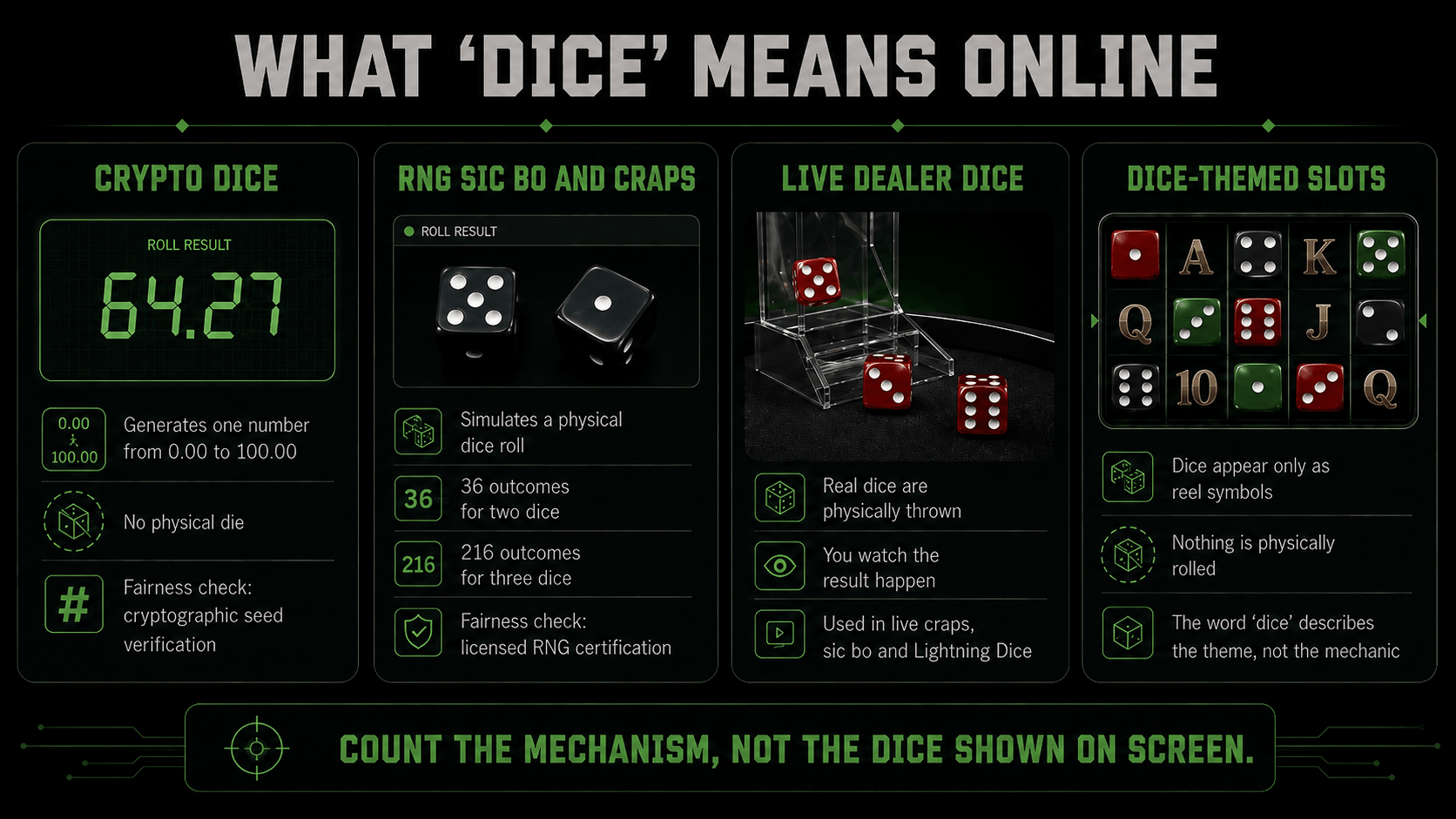
RNG versions of sic bo and craps are different. They model actual dice, so the 216 outcomes of three six-sided dice and the 36 of two behave exactly as the physical charts predict.
Two live games break the usual pattern of one, two or three dice. Bac Bo runs four, shaken in four separate machines, and they resolve as two independent pairs: the Player hand is the sum of two dice and the Banker hand the sum of the other two. The distribution that matters is therefore the 36-outcome one from a single pair, not anything built out of four dice. Football Studio Dice also uses four. Counting the dice on screen tells you less than knowing how they get grouped.
Multiplier variants change the price rather than the dice. Super Sic Bo adds random multipliers of up to 1000x to the standard three-dice game, and Lightning Dice does something similar across a narrower betting layout. All 216 outcomes stay exactly where they were, so the probabilities hold, while the payouts stop following from them in any straightforward way.
One more category earns a warning, because casino lobbies file it under dice. Wild Cash Dice and Fruit Party Dice are slot machines. The first is a five-by-three grid with ten fixed paylines and dice as reel symbols, and nothing in it is thrown or rolled at any point. In an online lobby the word dice is often a theme rather than a mechanic, and the reliable check is whether a result comes from a throw or from reels landing on paylines.
Fairness works differently when you can't pick the die up. Crypto dice games commit to a result before your bet using HMAC-SHA256 over a server seed, your own client seed and a nonce, then reveal the server seed once the seed pair is rotated so you can recompute every roll you made. What you're verifying is not that a cube is balanced but that the number was fixed before you staked anything. Our guide to provably fair systems walks through the check, crypto dice covers the format, and Stake Dice explained takes apart the most copied version of it.
What dice are made of
Casino dice are cellulose acetate, chosen for hardness, dimensional stability and the transparency the regulations demand. The trade-off is that the material yellows and clouds over years, which matters to collectors holding old stock rather than to a table that rotates its dice within a shift.
Everything else spans a wide range. Acrylic is cheap, durable and the default for mass-market dice. Resin allows colour effects and inclusions but varies in density, so balance depends on the pour. Metal dice are heavy and hard-wearing, and their weight tends to damage table surfaces. Wood, bone and stone all have long histories and all share the same problem: natural material has uneven density, so fairness is a matter of luck rather than specification.
A die is only as fair as its density distribution, which makes fairness a manufacturing question at least as much as a geometric one.
FAQ
How many types of dice are there?
There's no fixed number, because dice are defined by face count and construction rather than by a closed list. Six polyhedral shapes make up the standard set, sold as seven dice because it includes two d10s. Side counts from d2 to d120 are manufactured, and each of those exists in casual, precision and crooked versions.
What are the seven dice in a standard polyhedral set?
A d4, d6, d8, d10, a second d10 marked in tens for percentile rolls, a d12 and a d20.
What is a nine-sided die called?
Just a d9. No Platonic solid or trapezohedron has nine faces, so it's built as a rounded, truncated shape with nine resting positions and isn't balanced by symmetry the way a d6 is.
Do casinos use polyhedral dice?
No. Regulated dice games are built on sums of six-sided dice. Other Platonic solids are equally fair in principle, but the cube is the only one that is also cheap to machine to a 0.0005 inch tolerance and quick for a dealer to verify across a table.
What makes casino dice different from ordinary dice?
Sharp square edges instead of rounded ones, pips backfilled to the same density as the body instead of hollow recesses, transparent material, a tolerance of 0.0005 inches, matched serial numbers and retirement within hours of play.
Are online dice real dice?
It depends on the product. Live dealer sic bo, craps, Bac Bo and Lightning Dice use real dice you can watch being thrown. RNG sic bo and craps simulate real dice and match their odds exactly. Crypto dice games use neither and generate a single number from 0.00 to 100.00 with a uniform distribution. And games like Wild Cash Dice are slot machines with dice as reel symbols, where nothing is rolled at all.